A claim doing the rounds this week: a Chinese team has open-sourced a model that rebuilds any scene in 3D from ordinary video, in real time, from a single camera, with no LiDAR. Unusually for this genre of post, most of it holds up — but the details that got trimmed for the thread are the ones that decide whether it is useful to you.
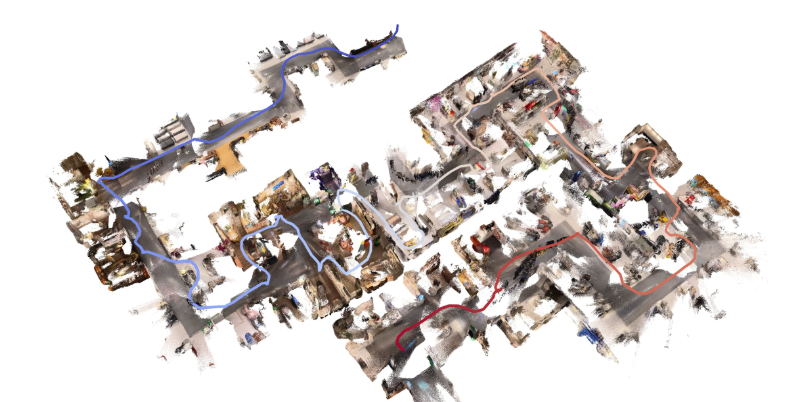
The project is LingBot-Map from the Robbyant Team, released under Apache 2.0 with over 12,000 GitHub stars and 1,300 forks.
What Is Actually True
The core claims check out. It is monocular — one ordinary camera, no depth sensor. It runs at roughly 20 FPS and stays stable across sequences of more than 10,000 frames, with a demonstrated 25,000-frame, 13-minute indoor walkthrough. It works on handheld footage, drone footage, driving video and indoor walkthroughs, and the team publishes benchmarks against KITTI, Oxford Spires, ETH3D and Tanks and Temples.
The architectural idea is borrowed from language models: paged KV cache attention, the same trick that makes long-context LLM inference practical, applied to a stream of video frames. Drift over long walks is handled with anchor context, a pose-reference window and trajectory memory.
What Got Left Out
- The 20 FPS is at 518×378. Real-time, yes. High resolution, no.
- You get point clouds, not meshes. No mesh export, no UVs, no textures, no FBX or GLB. This is the single most important omission for anyone imagining game-ready assets.
- “A single GPU” means a single NVIDIA GPU. Installation expects CUDA 12.8 and PyTorch 2.8. A community fork exists specifically to make it fit on 8 GB cards.
- Long sequences need configuration. Beyond roughly 320 frames you set keyframe intervals; beyond a few thousand you switch to windowed inference. The documentation is honest that pose collapse happens otherwise.
Why It Still Matters
The licence, more than the frame rate. Apache 2.0 permits commercial use, which is rare for a model at this capability level and is what makes the 1,300 forks meaningful — people are building on it, not just starring it.
It is also worth noting where this comes from. Robbyant also publishes a world model, and the reconstruction pipeline runs on its generated footage out of the box. This is robotics and spatial-AI research that happens to be extremely useful to 3D artists, rather than a tool built for them.
What This Means for 3D Artists
Not much today, and quite a lot within a year. Right now, if you want a textured mesh of a real location, conventional photogrammetry still beats it, because a point cloud is a starting point rather than an asset.
What changes is the cost of capture. Walking through a space with a phone and getting accurate geometry and camera tracking in minutes rather than hours is a different workflow to photogrammetry, particularly for previs, set scanning and matchmove reference. The missing piece is the mesh-and-texture layer on top, and given the licence, someone will build it.
It fits a pattern we covered with NVIDIA’s text-to-motion model running locally: heavy research models are becoming runnable on normal hardware, and the artist-facing tools arrive one layer later.