Alibaba’s PAI team has released a ControlNet-Union for MiniMax-H3: one checkpoint, five control types, and video output with native audio. For anyone working in 3D, it is more interesting than the usual AI model release, because every control signal it accepts is something you can render directly out of Blender.
What Was Actually Released
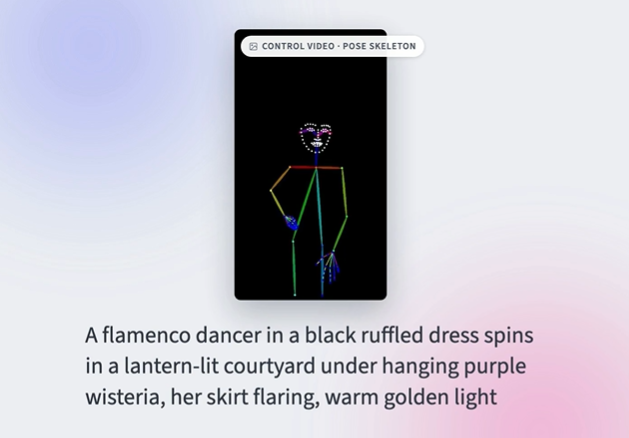
The model conditions the MiniMax-H3 video generator on Canny, Depth, HED, MLSD and Pose control videos from a single checkpoint — no switching models per condition. It also handles video inpainting. It was trained with Alibaba’s VideoX-Fun pipeline, the same lineage as their ControlNet Unions for FLUX.2, Qwen-Image and Z-Image.
Two corrections to how this is circulating. The fifth control type is MLSD — a straight line-segment detector, useful for architecture and hard-surface — not “ML”. And this is a video ControlNet, not an image one; the input is a control video and the output is a generated clip.
The Part That Matters for 3D Artists
Depth passes, pose data and edge outlines are not exotic AI artefacts. They are standard 3D outputs. Blender gives you a depth pass from the compositor, pose from any armature, and outlines from Freestyle or an edge detect node.
Which means the workflow is now: block out a shot in 3D with grey clay and no lighting, render the depth or pose sequence, feed it in as the control video, and let the model produce a finished-looking clip that follows your exact camera move, staging and timing.
Text-to-video gives you almost no control over composition. This gives you all of it, because the composition is yours — you built it in a viewport. The prompt only decides what things look like.
Why It Is Faster Than Expected
The checkpoint is guidance-distilled, meaning it runs at guidance scale 1.0 with a single forward pass per step instead of the two that classifier-free guidance normally requires. In practice that roughly halves the compute per step. The control branch itself is light, attaching to only 5 of the model’s 50 transformer blocks through zero-gated projections.
The Catches
- It is not Apache-licensed. This ships under the MiniMax H3 Community License — commercial use permitted below a revenue threshold, with attribution required. “Open weights” is not the same as “open source”, and the distinction matters if you are delivering client work.
- The hardware bar is high. The ControlNet alone is about 6.8 GB, and it sits on top of a large omni-modal base model that generates 2K video with audio.
- Setup is developer-grade. Clone the VideoX-Fun repository, download two sets of weights, edit a Python script. There is no Blender add-on and no one-click installer.
Where This Is Heading
The interesting signal is not this checkpoint specifically — it is that AI video is converging on 3D data as its control layer. Depth, pose and edges are the vocabulary, and 3D artists already speak it fluently.
The likely near-term outcome is previs and animatics: block a sequence roughly, generate a look, iterate on staging in the viewport rather than in a prompt box. That is a genuine use for a tool that cannot yet hold a character consistent across shots.
It also fits the pattern we noted with kimodo.cpp and LingBot-Map: the research ships first as raw weights and scripts, and the artist-facing tooling arrives a layer later.