Blender will run on almost anything. Blender will run well on much less than people claim. Here is what actually matters, in order, so you do not overspend on the wrong component.
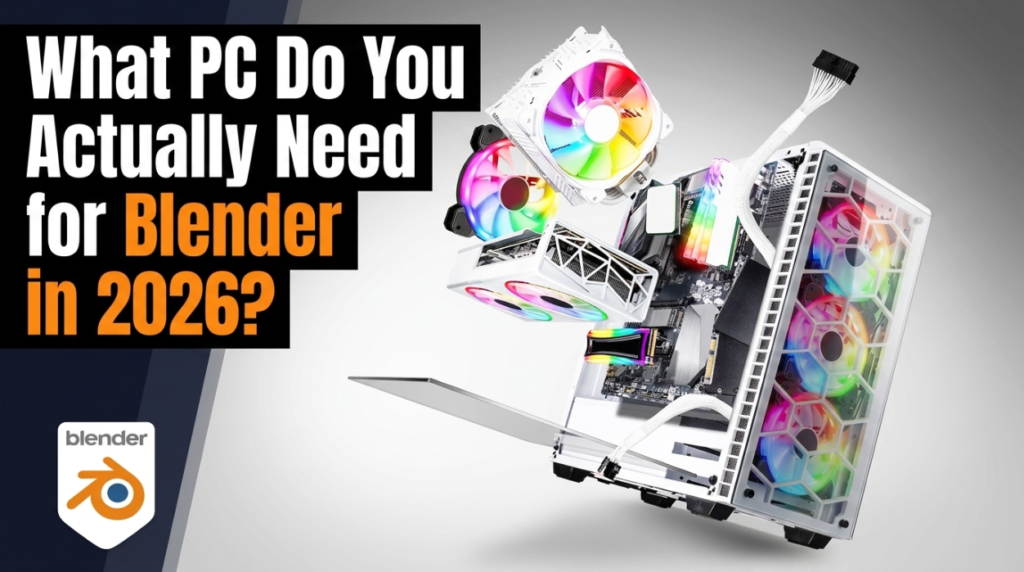
What Matters Most?
1. RAM, then GPU VRAM, then CPU. That order surprises people who assume the graphics card is everything.
Running out of memory does not make Blender slow, it makes Blender crash. Running out of VRAM forces GPU rendering back onto the CPU, which is dramatically slower. A fast CPU with insufficient memory performs worse than a modest CPU with plenty.
Realistic Requirements by Use
- Learning and simple scenes — 16 GB RAM, any dedicated GPU with 4–6 GB VRAM. Genuinely fine.
- Serious hobby work — 32 GB RAM, 8–12 GB VRAM. This is the sweet spot for most people.
- Heavy sculpting, simulation, dense scenes — 64 GB RAM, 16 GB+ VRAM.
NVIDIA or AMD?
For Blender specifically, NVIDIA remains the safer choice. Cycles has the most mature support through OPTIX, and a great deal of third-party tooling — particularly AI tools — assumes CUDA. AMD works, and works well in EEVEE, but you will occasionally hit software that simply expects NVIDIA.
If you plan to use AI tools alongside Blender, the decision is effectively made for you.
Where People Waste Money
- Top-tier CPUs. Unless you render on CPU, the money belongs in RAM and VRAM.
- High refresh-rate monitors. Colour accuracy and resolution matter far more than 240Hz.
- Gaming-branded everything. You are paying for lighting effects.
Where People Underspend
- RAM. The cheapest meaningful upgrade in 3D, and the one that removes crashes.
- Storage. An NVMe drive changes how quickly large files open and cache.
- Power supply. An undersized PSU causes crashes that look like software bugs — including GPU driver failures.
Can You Learn Blender on a Laptop?
Yes, and most people do. Prioritise RAM, ensure a dedicated GPU, and accept that render times will be longer. Nothing about learning 3D requires a workstation — it requires a machine that does not crash while you practise.
More free tools in the 3DxDEV Library.