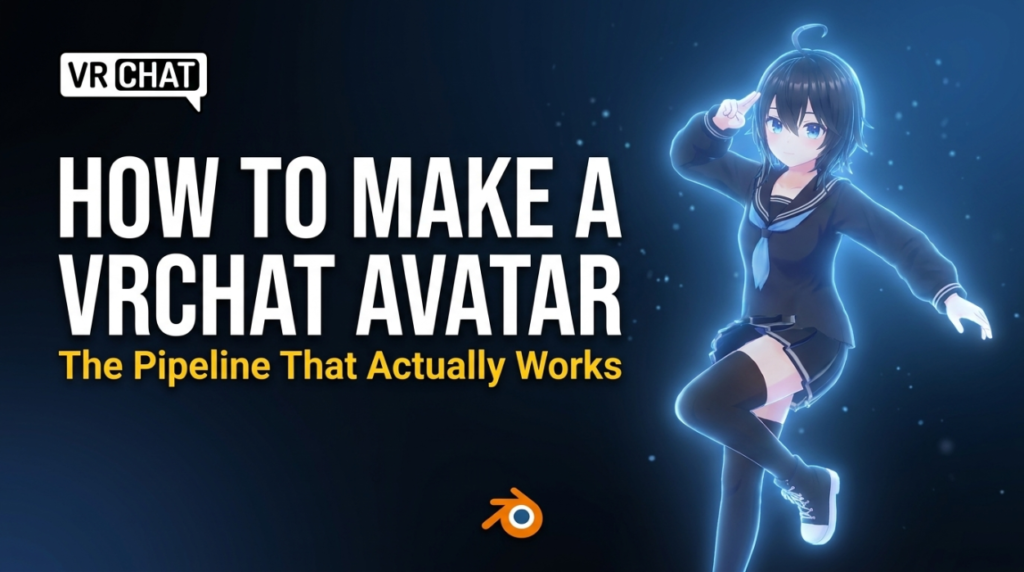
Making a VRChat avatar is less about modelling than most people expect and more about a specific Unity pipeline. Here is the actual path, and where beginners lose weeks.
The Pipeline in Order
- Model and rig — usually Blender. Humanoid rig, correct bone naming.
- Export to Unity — FBX, with the rig set to Humanoid on import
- Install the VRChat Creator Companion — this manages your Unity version and SDK, and using the wrong Unity version is the single most common beginner failure
- Set up the avatar descriptor — viewpoint, visemes, eye look
- Add clothing, toggles and gestures
- Optimise, then upload
Where People Actually Get Stuck
Not modelling. Almost always the Unity stage — specifically animator layers, menus and parameters.
Adding a single toggleable accessory traditionally meant editing your FX controller, adding a menu entry and registering a synced parameter. Get any of it wrong and the avatar uploads broken. Get the bone parenting wrong and you break animations that worked yesterday.
This is why VRCFury became near-universal. It handles clothing attachment, toggles and controller merging non-destructively — applying changes at upload time rather than editing your files. If something goes wrong, you remove it and nothing was ever changed.
Performance Ranks Are Not Optional
VRChat rates avatars from Excellent to Very Poor based on polygon count, material count, mesh count, bones and more. Users can and do block avatars above a chosen rank — so a beautiful Very Poor avatar is one many people will simply never see.
The main levers are the ones that matter in any real-time pipeline: fewer materials, fewer separate meshes, sensible polygon budgets, smaller textures. Our guide to optimising models for games applies directly.
Fitting Clothing
The other reliable time sink. Weight painting a garment to a body by hand is slow, and Blender’s Data Transfer modifier fails on gaps — armpits, loose sleeves, skirts.
Solve it before Unity with Robust Weight Transfer, which handles exactly those cases.
Buy or Build?
Most VRChat avatars start as purchased bases, and there is no shame in it — the platform’s creator economy is built on it. Check the licence though: many bases restrict resale of derived avatars, and some prohibit public distribution entirely.
Building from scratch teaches more but takes far longer, and the Unity pipeline is the same either way.