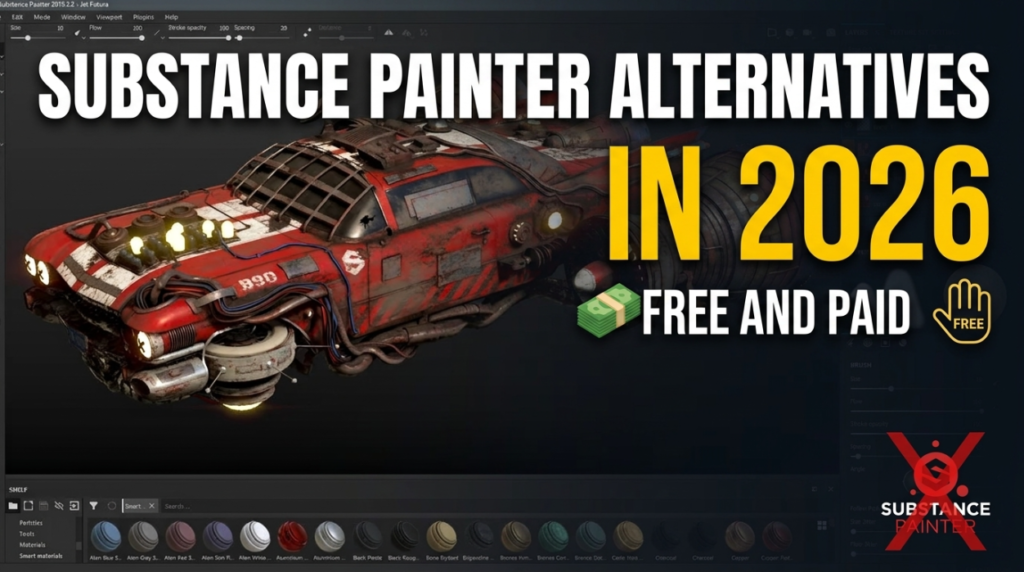
Substance Painter is the industry standard and costs a subscription. Search interest in alternatives keeps climbing, so here is what actually exists — and what you give up.
The Free Options
ArmorPaint is open source, GPU-accelerated PBR texture painting. It covers the core loop: paint materials onto a model, layer them, export PBR maps. The interface is sparse and the ecosystem is small, but the fundamentals work.
Material Maker is free, open source and node-based — closer to Substance Designer than Painter. If you want to build procedural materials rather than paint them, this is the tool.
Blender itself is underrated here. Texture paint mode plus Geometry Nodes and a decent baking setup covers a great deal, and it is already in your pipeline. For many stylised projects, leaving Blender is unnecessary.
Quixel Mixer is free and mixes scanned materials, though it is a different workflow to painting from scratch.
The Paid Alternatives
Instamat has been gaining attention as a newer entrant. 3D Coat offers texturing alongside sculpting and retopology, sold as a perpetual licence rather than a subscription — which for many freelancers is the actual point.
What You Give Up
Being honest about the gap:
- Smart materials — Substance’s procedural masks that read curvature and ambient occlusion to place wear automatically. This is the biggest single loss.
- The asset library — thousands of ready materials and alphas
- Pipeline integration — studios expect Substance files, and interoperability matters when you join a team
- Baking quality — Substance’s bakers are mature and handle edge cases well
Who Should Actually Switch
Solo artists, hobbyists and anyone doing stylised work where procedural wear matters less. If your materials are hand-painted or flat-shaded, most of what you pay Substance for is unused.
Who should not: anyone working in or aiming at a studio pipeline, and anyone doing photoreal hard-surface where smart materials do genuine heavy lifting.
The Underlying Skill
Whichever tool you use, the thing that makes materials convincing is roughness variation. A single flat roughness value is the clearest marker of inexperienced work, and no software fixes that for you.
Our guide to PBR explained properly covers what each map is actually doing.