This argument has been running for twenty years, and in 2026 the honest answer has changed. Blender is no longer the scrappy free option you settle for. But Maya is not going anywhere either, and pretending otherwise does beginners real harm when they hit the job market.
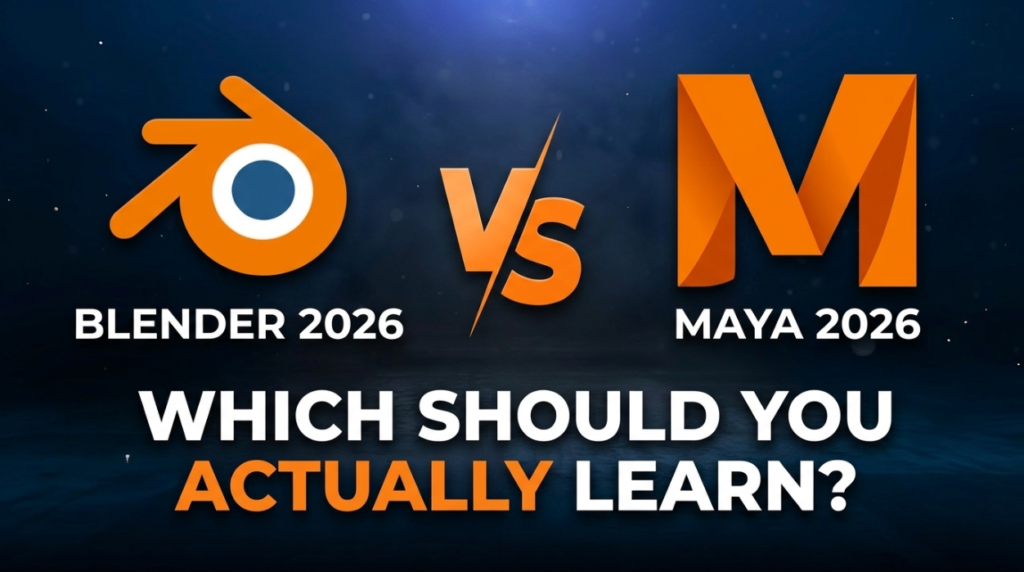
Which Is Better for Getting a Job?
Maya, in most large studios. Film, VFX and AAA game pipelines are built around it, and job listings still name it far more often than Blender. If your goal is a staff animation job at an established studio, learning Maya is the pragmatic choice.
That said, Blender has moved from unwelcome to accepted at a growing number of studios, and it is now common in indie games, motion graphics, archviz and freelance work.
Which Is Better for Solo Artists and Indies?
Blender, decisively. It covers modelling, sculpting, UV, texturing, rigging, animation, simulation, rendering, compositing and video editing in one free package. Maya is a subscription that runs well over a thousand dollars a year, and it does not include a sculpting suite, a compositor or a video editor in the same way.
For a solo artist, the money argument is not really about price. It is that Blender lets you do the whole pipeline without stitching together four subscriptions.
Which Has Better Animation Tools?
Maya still leads. Its graph editor, animation layers and rigging ecosystem are more mature, and character TDs have decades of accumulated tooling. Blender has closed the gap significantly, and free rigging systems like Rigify and Auto-Rig Pro alternatives are genuinely production-capable, but Maya remains the stronger animation package.
Which Has Better Modelling and Sculpting?
Blender wins on breadth. Its modifier stack, Geometry Nodes and built-in sculpting are excellent, and free add-ons extend it further than Maya’s free ecosystem does. Maya’s modelling is strong and predictable, but you will be buying plugins for things Blender ships with.
What About Rendering?
Blender ships Cycles and EEVEE for free. Maya ships Arnold with limited licences and expects you to license more, or buy V-Ray or Redshift. For solo work this is another large hidden cost on the Maya side.
Should You Learn Both?
Eventually, yes, and it is easier than it sounds. The concepts transfer almost entirely: topology, UVs, rigging logic, animation principles and shading theory are software-agnostic. Learning your second package is mostly learning new hotkeys and menu names, not new skills.
The practical path: start in Blender because it is free and you can begin today, build a portfolio, then learn Maya if you target studio employment.
The Bottom Line
Choose Blender if you are self-funded, working solo or in a small team, doing indie games, freelance, archviz or motion graphics, or simply starting out. Choose Maya if you are aiming at a large studio animation or VFX career, or your collaborators already use it.
Explore free tools for both in the 3DxDEV Library and our full 3D resources directory.