Retopology is the least glamorous part of 3D and one of the most expensive to automate well. AutoRemesher 1.1.0 is out, and it rebuilds a substantial part of its pipeline while staying free and MIT licensed.
The Headline Change: Geogram Is Gone
The biggest structural change is that the external Geogram dependency has been replaced with a native quad parameterizer written into AutoRemesher itself. That sounds like housekeeping, but parameterization is what determines how quads flow across a surface — so the practical result is cleaner UV layouts and better quad extraction, not just a tidier dependency tree.
Anisotropic Quad Sizing
New in this release is anisotropic quad sizing, exposed as an --anisotropy option on the command line. Rather than forcing every quad toward a square, you can let quads stretch along the direction the surface actually flows.
For elongated forms — limbs, tree trunks, drapery, anything tubular — that usually means fewer polygons for the same silhouette quality.
Better Final Meshes, and Fewer Crashes
Extracted quads are now smoothed and projected back onto the input mesh, which reduces the drift you sometimes get where a remeshed surface floats slightly off the original. Six-edge faces are split during extraction, and several crashes involving non-manifold geometry have been fixed — relevant to anyone feeding it raw scan data, which is rarely clean.
The Feature Nobody Asks For Until They Need It
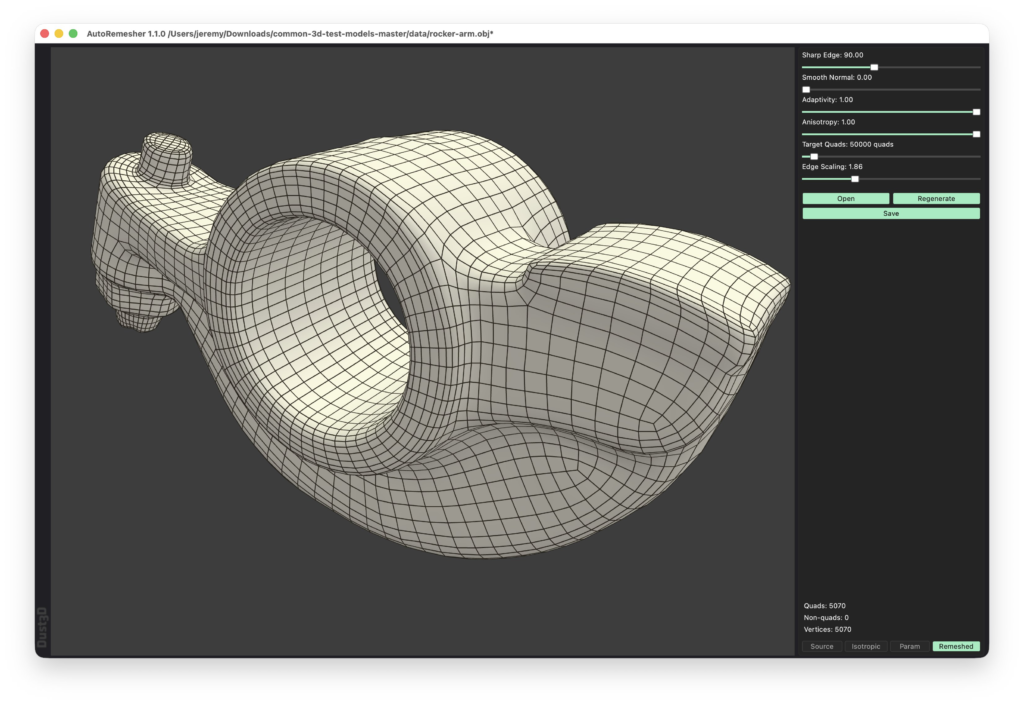
You can now inspect the pipeline stage by stage: source, isotropic, parameterization and remeshed model each get their own preview, with singular vertices and extracted connections visible.
When an auto-remesher produces garbage, the usual experience is a black box and a shrug. Being able to see which stage broke turns a guessing game into a fixable problem — and tells you whether to clean the input or change a parameter.
Still MIT, Still Free
AutoRemesher moved from GPLv3 to the MIT licence at version 1.0 earlier this year, with the author reimplementing MIT-incompatible dependencies specifically so it could be used in commercial work. That remains its strongest argument. Builds are available for Windows, macOS and Linux, alongside a headless CLI for batch processing.
Where It Sits Against the Alternatives
Instant Meshes is still the more forgiving option on badly formed geometry. ZRemesher and Quad Remesher still win on deliberate edge flow for characters, and both cost money. AutoRemesher’s pitch is the combination: free, commercially usable, scriptable, and now with real visibility into why a result failed.
It will not replace a character artist laying loops around a mouth by hand. For scans, sculpts, kitbashes and the growing pile of AI-generated meshes that arrive as triangle soup, it is a genuinely useful first pass — and it is a reminder that not every improvement in 3D tooling this year has been a model checkpoint.
More free tools in the 3DxDEV Library and our resources directory.