Retopology is the part of 3D nobody defends. As one artist put it when Tractive was announced, automating it is like AI taking a job where the job is rubbing sandpaper on yourself. Unsurprisingly, several teams are now trying to solve it — and the AI-retopology field has quietly become crowded.
Here is what is actually available, what is vapour, and what you can use today.
Tractive: Control Over Automation
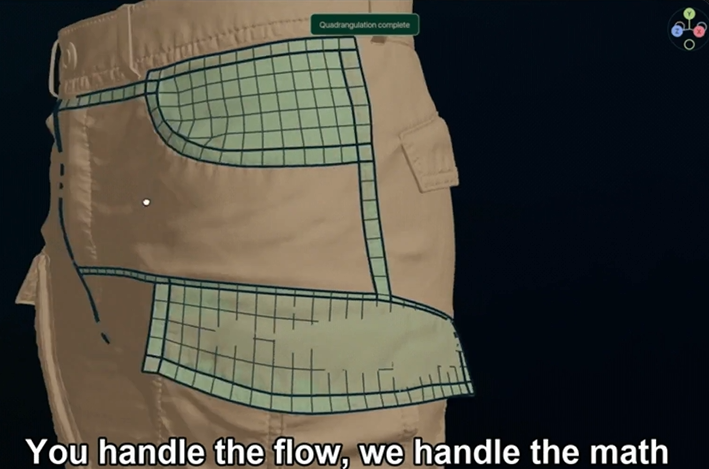
Tractive, from Oxford computer-vision PhD Mohsan Alvi, is the most talked-about. Rather than running the whole model through a black box, you annotate regions, draw loops and move boundaries, and the quads recalculate and reconcile around your choices. No committing to a quad count up front.
The developer compares it to ZBrush’s ZRemesher guides, but stricter — more control over exactly where loops sit and how they flow into each other. The company says it has developed the tool in collaboration with game studios including Rocksteady, Supercell and Jagex.
Status: Early access opened in mid-2026 to a small group, demand overwhelmed capacity, now a waitlist. No public pricing.
CozyBlanket Pro: The Same Bet From an Established Studio
Sparseal — the team behind CozyBlanket, Wafer and Uniform — announced CozyBlanket Pro, also targeting AI retopology, and extending into UV unwrapping, GPU-based packing and texture baking.
That broader scope is the notable difference. Sparseal also has a track record of actually shipping, which counts for something in a field this full of announcements.
Status: Closed beta, with early-access signup.
Sketch-Based Approaches
Rayen Bahri has been developing a pen-like tool where you sketch a shape in a few strokes and matching quad topology is generated, with strokes behaving like vector paths in 3D. It is an experiment with no release date, supported through Patreon. RetopoFlow and TopoGun already occupy this space commercially.
What You Can Actually Use Today
Everything above is a waitlist, a beta or an experiment. The tools that exist right now:
- AutoRemesher — free, MIT licensed, GUI and CLI, just updated to 1.1 with a rebuilt parameterizer
- Instant Meshes — free, older interface, still the most forgiving on messy geometry
- ZRemesher — inside ZBrush, still the quality benchmark for characters
- Quad Remesher — paid, available for most major DCCs
- RetopoFlow — paid, manual but purpose-built for Blender
Why AI-Generated Meshes Made This Urgent
The real driver behind this wave is not that retopology got harder. It is that the volume of meshes needing it exploded.
Tools like Hunyuan3D, Meshy, Rodin and Tripo produce models that look fine in a static render and are close to unusable downstream — triangle soup, no edge flow, nothing that survives rigging. Generation got cheap while cleanup stayed expensive, and that gap is exactly the market these tools are chasing.
The Honest Assessment
The unanswered question for every tool here is deformation-heavy geometry. Faces, shoulders, elbows, hands — the places where topology has to anticipate how a mesh will bend, not just cover a surface efficiently. Demos rarely show these, and that is precisely where retopology is difficult.
The likely realistic outcome is not automation but acceleration: AI produces a strong first pass, and an artist fixes the deformation-critical areas by hand. That would still be a substantial time saving on work almost nobody enjoys.
Worth noting too that Tractive has not published how its algorithm works or which parts are genuinely AI, and the same opacity applies across most of this category. Treat the demos as demos until you have run your own mesh through.
More tooling in the 3DxDEV Library and our resources directory.