Search interest in “blender mcp” has been climbing steadily, and most people encountering the term have the same question: is this a Blender feature, an add-on, or an AI thing? It is the third, and it is more interesting than the usual AI-in-3D story.
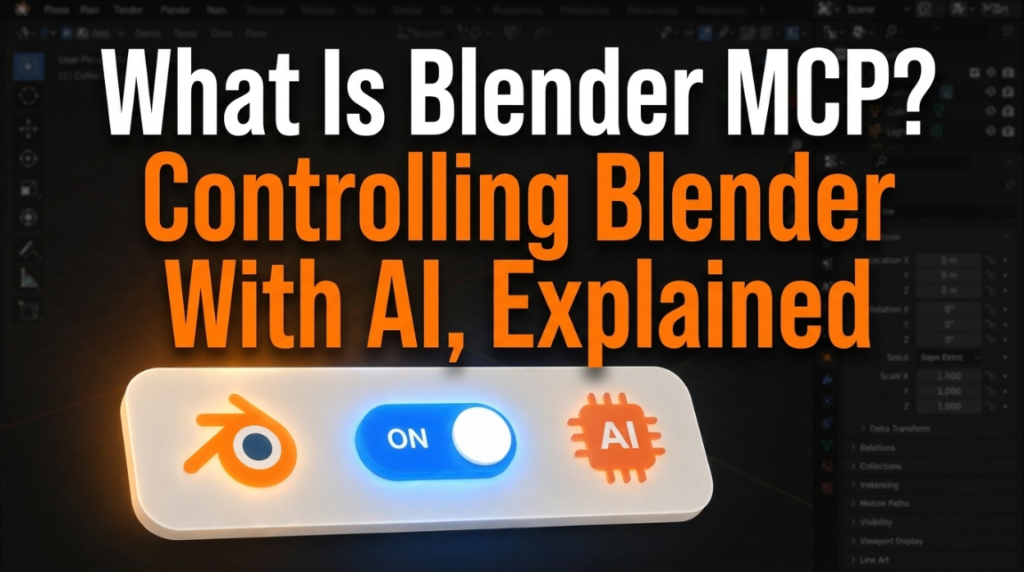
What Is Blender MCP?
MCP stands for Model Context Protocol, an open standard for letting AI assistants talk to external applications. Blender MCP is an implementation that exposes Blender to an AI assistant, so the assistant can inspect your scene and run operations in it.
The distinction that matters: this is not a generative model producing a mesh. The AI is driving Blender — issuing the same operations you would perform manually. Your scene stays your scene, built from real Blender data, not imported from a black box.
How Does It Actually Work?
Three pieces: a Blender add-on that opens a socket inside Blender, an MCP server that translates between the assistant and that socket, and an AI client that connects to the server.
Once connected, the assistant can query scene contents, object properties and materials, then execute Python against Blender’s API. Because Blender’s Python API reaches almost everything the interface does, the practical ceiling is high.
What Is It Genuinely Good At?
From real use, the wins cluster in specific places:
- Tedious repetitive operations — renaming hundreds of objects to a convention, batch-assigning materials, cleaning up a messy imported hierarchy. Work that is trivial but takes an hour.
- Scene interrogation — asking which objects have no UV maps, which materials are unused, what is driving your poly count. Faster than clicking through outliner panels.
- Geometry Nodes scaffolding — getting a node setup roughly assembled so you refine rather than start from an empty graph.
- Learning the Python API — watching correct
bpycalls execute against your own scene teaches the API faster than documentation does.
Where It Falls Down
Being honest about this matters more than the feature list:
- It cannot see your viewport. It reads scene data, not your render. Asking whether something “looks right” is asking the wrong question of the wrong tool.
- Aesthetic judgement is not there. It will place objects at coordinates. It will not tell you the composition is weak.
- Complex multi-step operations drift. The more steps between instruction and result, the more likely something lands subtly wrong.
- It runs arbitrary Python in your Blender session. That is genuine power and genuine risk — save before you experiment.
Is It Safe?
Treat it the way you would treat running a script you found online, because functionally that is what it is. The add-on opens a local socket; keep it local, do not expose it to a network, and disable the connection when you are not using it.
Save your file before running anything substantial. Undo does not always cover operations executed through the API the way it covers interface actions.
Who Should Bother?
Technical artists and anyone who already writes Python for Blender — this makes an existing workflow faster, and you can read what it is doing and catch mistakes.
If you do not write Python and do not want to, the payoff is smaller, because the failure modes are hard to diagnose without understanding what was executed.
Blender MCP vs AI 3D Generators
Worth separating clearly, since they get conflated constantly.
AI generators — Tripo, Meshy, Rodin, Hunyuan3D — produce a finished mesh from a prompt or image. Fast, and the output typically has poor topology that needs retopology before it is usable.
Blender MCP does not generate meshes. It operates Blender. The output is native scene data with whatever topology the operations produced — which is why it fits a real pipeline more comfortably.
Frequently Asked Questions
Does it work offline?
The Blender side runs locally, but the AI assistant is usually a cloud service, so scene information you share leaves your machine. Consider that before pointing it at client work.
Which Blender versions are supported?
Support depends on the specific implementation you install, and this space moves quickly. Check the project’s own documentation against your Blender version rather than trusting any article, including this one.
Can it replace learning Blender?
No, and the reverse is closer to true. It is most useful to people who already know what they want done and can tell when the result is wrong.
Is it free?
The protocol and most implementations are open source. Costs come from whichever AI assistant you connect, if that service charges.
The Realistic Take
Blender MCP is not going to model your character. What it does well is remove the administrative layer of 3D work — the renaming, the batch edits, the scene audits, the boilerplate Python — which is a meaningful share of the day for anyone working at scale.
Rising search interest suggests people are figuring that out. Expect the tooling to consolidate, and expect the honest use case to stay narrower than the demos imply.
More free Blender tooling in the 3DxDEV Library.