Type a prompt or upload a photo, wait a minute, download a 3D model. That is the promise, and it broadly works now. What almost nobody explains is what you actually receive — and why it often cannot be used without significant work.
This is a practical look at where AI 3D generation stands in 2026, what the output is genuinely good for, and where it fails.
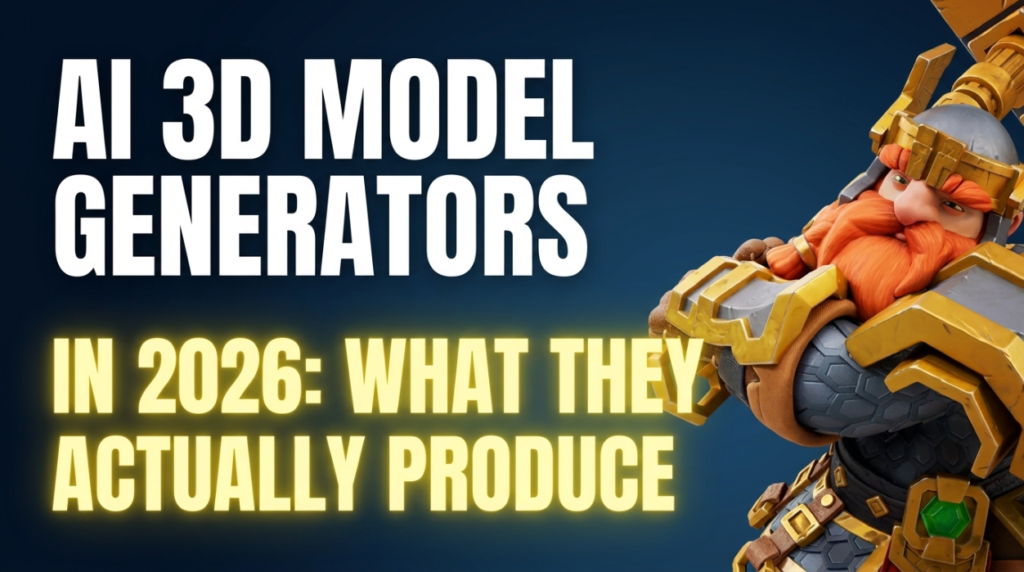
What Do AI 3D Generators Actually Produce?
Almost all of them output a dense triangle mesh with an automatically generated UV layout and a baked texture. Silhouette and colour are usually decent. What you do not get is topology anyone would author by hand: no considered edge flow, no clean quads, no loops placed where a face or a joint needs them.
For a static render, that is often fine. For anything you need to rig, animate, edit or optimise, it is a starting point rather than an asset — which is why AI generation and retopology tools have been growing in tandem.
The Main Tools
- Tripo AI — among the fastest and most widely used, with text-to-3D and image-to-3D, free credits and paid tiers. Strong for props and quick concepting.
- Meshy — similar scope, with texture generation and stylised output options. Popular for game-ready-ish props.
- Rodin (Hyper3D) — generally regarded as producing cleaner results, with more control over output quality.
- Hunyuan3D — Tencent’s open-weights model, notable because you can run it locally rather than paying per generation.
- Womp — a different proposition: browser-based 3D creation aimed at people who do not use traditional DCCs, rather than a pure prompt-to-mesh generator.
Pricing across this category changes constantly and most operate on credits, so check current terms before committing to any of them.
What Are They Genuinely Good For?
- Concepting — generating twenty variations of a prop to find a silhouette worth modelling properly
- Background and set dressing — objects the camera never gets close to
- Blockout and previs — filling a scene fast to test composition and scale
- Reference — a rough 3D form to sculpt over is more useful than a flat image board
Where They Fail
Characters that deform. Generated topology will not survive rigging. Loops are not where they need to be, and no amount of prompt engineering changes that.
Hard-surface precision. Mechanical parts, panel lines and anything requiring exact dimensions come out approximate. Approximate is not useful on a machine part.
Editability. Dense triangles with automatic UVs are painful to modify. Adjusting a generated mesh is frequently slower than modelling the object yourself.
Style consistency. Generating twelve props that look like they belong in the same game is much harder than generating twelve good props.
The Workflow That Actually Works
Treat generation as step one of four:
- Generate the rough form
- Retopologise — AutoRemesher is free and handles props well; characters need manual work
- Re-UV and re-bake, since the generated UV layout is rarely worth keeping
- Fix the details the model got approximately right
Done this way, generation genuinely saves time on props and environment fill. Skipping straight from generation to engine is where people end up with a project full of unusable geometry.
Licensing: Check Before You Ship
This is the part people skip and later regret. Terms vary widely across these services and change often. Some allow commercial use on paid tiers only; some restrict it on free output entirely; open-weights models carry their own licences that may not be as permissive as “open” implies.
Read the actual terms of the specific service before shipping generated assets in a commercial product. “It was free” is not a licence.
Frequently Asked Questions
Can I use AI-generated models in a commercial game?
Depends entirely on the service’s terms and your tier. Check them per tool, and keep a record of what you generated where.
Which is best for game assets?
None of them produce game-ready assets directly. The best workflow is generate, retopologise, re-UV, bake. Tools with cleaner base output reduce that cleanup but do not eliminate it.
Is there a free option that runs locally?
Hunyuan3D is the notable open-weights option, which avoids per-generation costs and keeps your work off someone else’s servers. Expect real hardware requirements.
Will this replace 3D artists?
It has already changed what junior prop work looks like. What it has not done is remove the need for someone who can judge topology, deformation and style consistency — which is most of the actual skill.
The Honest Summary
AI 3D generation in 2026 is a strong concepting and set-dressing tool with a mandatory cleanup step. Anyone selling it as a one-click replacement for modelling is describing a demo, not a pipeline.
Browse free cleanup and retopology tools in the 3DxDEV Library, or see our full resources directory.