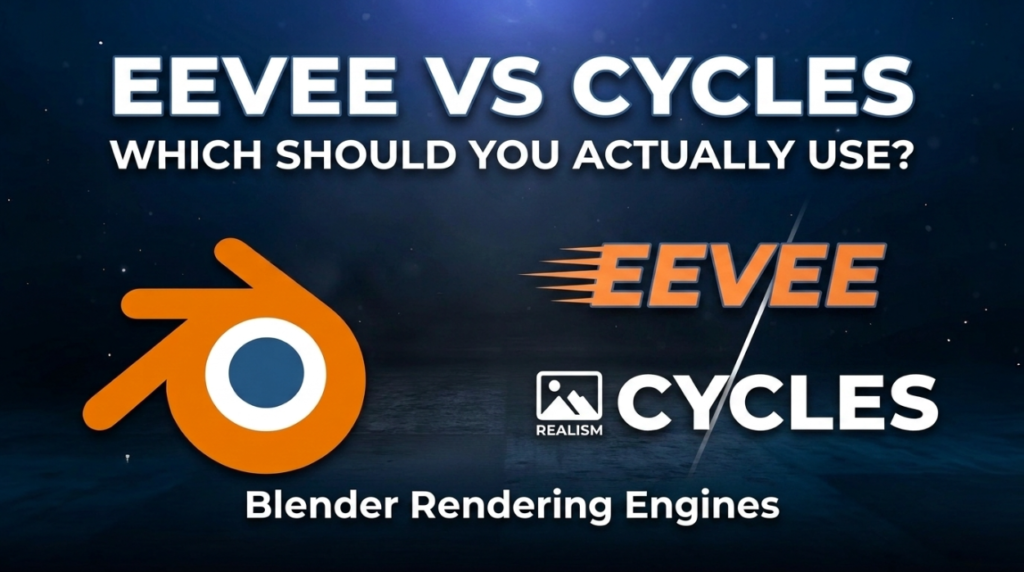
Choosing between EEVEE and Cycles is not a quality decision. It is a decision about what you are willing to wait for, and what your image actually needs.
The Core Difference
Cycles is a path tracer. It simulates light bouncing through your scene, which is why it produces accurate reflections, refractions, caustics and indirect lighting — and why it is slow.
EEVEE is a rasteriser. It approximates those effects using techniques from real-time game rendering. It is dramatically faster and, in many scenes, close enough that nobody could tell.
When to Use Cycles
- Glass, liquids, gemstones — anything where refraction matters
- Interior scenes lit indirectly, where light bouncing off walls is the lighting
- Product renders and archviz where accuracy is the deliverable
- Accurate soft shadows and contact shadows
When to Use EEVEE
- Animation, where render time multiplies by frame count
- Stylised, toon and NPR work, where physical accuracy is irrelevant
- Motion graphics and abstract renders
- Look development — iterate in EEVEE, final in Cycles
- Anything on a deadline
The Workflow Most People Should Use
Build and light in EEVEE because feedback is instant. Switch to Cycles only when you need what Cycles offers. Many artists never switch at all, and their work is fine.
The mistake is defaulting to Cycles for everything out of a vague sense that it is the “real” renderer, then spending your evening waiting on an image whose subject is a stylised character with flat materials.
Where EEVEE Visibly Falls Down
Refraction through complex glass, accurate caustics, and indirect light in enclosed spaces. If your scene depends on any of those, EEVEE will look wrong in ways you cannot fix with settings.
Everything else is usually a matter of setup rather than a limitation.
The Short Version
Cycles for realism and stills. EEVEE for animation, stylisation and iteration. Judge by what the image needs, not by which renderer sounds more serious.
More Blender tools in the 3DxDEV Library.