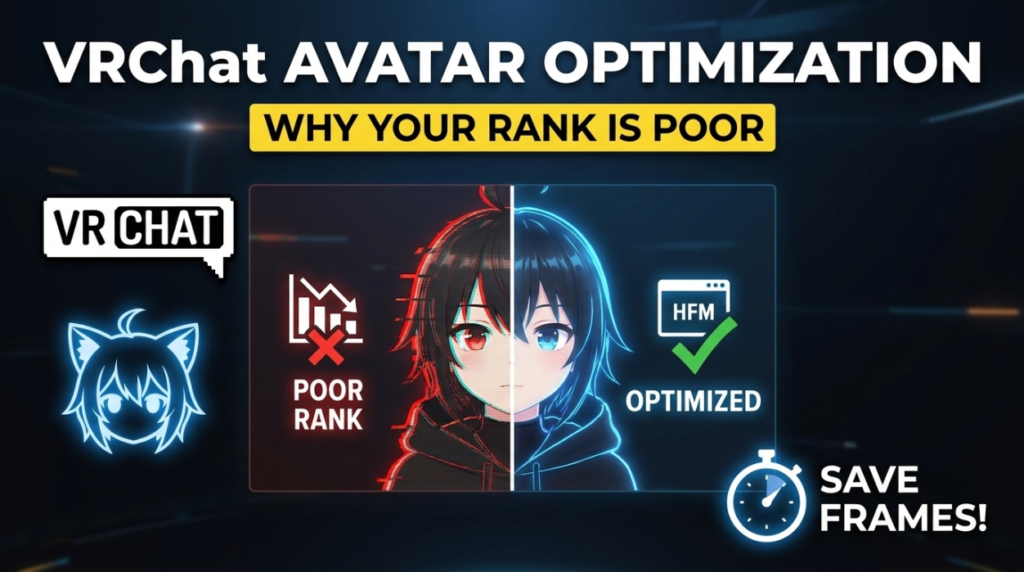
VRChat rates every avatar from Excellent down to Very Poor. Users can set a limit and block anything above it — which means a beautiful Very Poor avatar is one a large share of players will never actually see.
Optimisation is not a technical nicety here. It decides whether you are visible.
What Actually Counts Against You
People fixate on polygon count. It matters, but it is rarely the thing pushing an avatar into a bad rank. The bigger offenders:
- Material count — each material is a draw call. This is usually the worst offender.
- Mesh count — separate objects cost more than one merged object at the same polygon count
- Texture memory — several 4K textures on an avatar nobody sees close up
- Bones — especially physbones on hair, clothing and accessories
- Particle systems and lights — disproportionately expensive
The Fixes, in Order of Impact
1. Atlas your textures and cut materials. Combining several materials into one atlas is the single largest win available on most avatars.
2. Merge meshes. Instead of many toggleable objects, keep one mesh and use material slots and blendshapes to show and hide parts.
3. Right-size textures. 4K on a small accessory is wasted memory. Most avatar parts look identical at 1K or 2K.
4. Audit physbones. Every chain costs. Long hair with per-strand physbones is a common quiet disaster.
5. Decimate what nobody inspects. Inner surfaces, hidden geometry under clothing, and dense areas that read the same at half the density.
Tools That Help
VRCFury includes a blendshape optimiser that cuts VRAM usage, and its non-destructive approach means you can test optimisations without permanently altering your avatar files.
Shaders that support offline locking or optimisation also reduce cost meaningfully.
The Quest Problem
Quest builds have far tighter limits than PC. The practical approach is separate builds, with reduced geometry, fewer materials and simpler shaders on the Quest version — not one avatar trying to satisfy both.
The Underlying Principle
None of this is VRChat-specific. Draw calls, texture memory and mesh count are the same constraints in any real-time engine — see our guide to optimising 3D models for games.
Learning it for VRChat teaches you game art optimisation generally, which is a more transferable skill than the platform suggests.