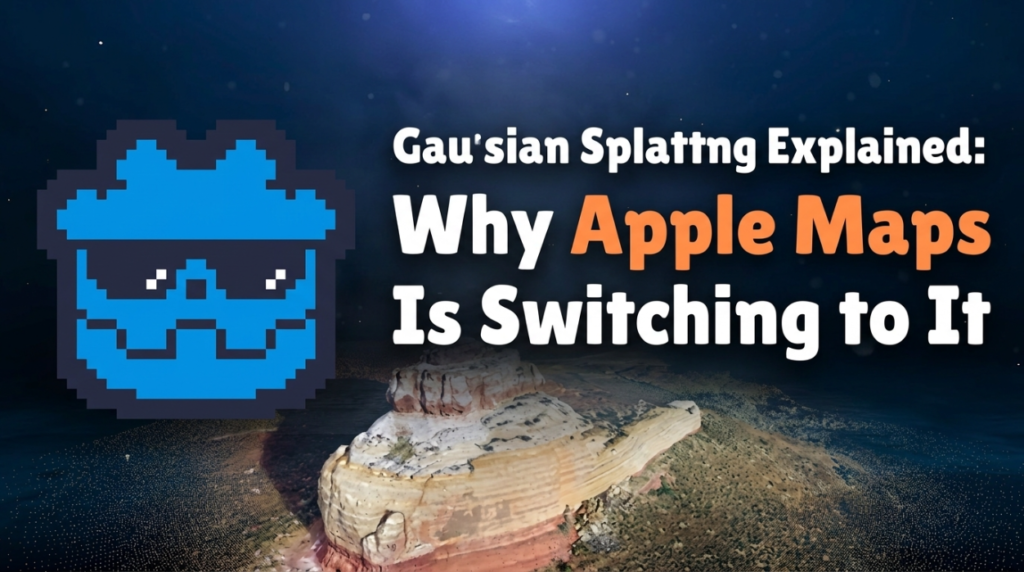
Gaussian splatting stopped being a research curiosity some time ago. At WWDC in June 2026, Apple announced that Apple Maps Flyover is moving to 3D Gaussian splatting — across a feature that already spans more than 300 cities and landmarks, previously built on conventional drone photogrammetry.
That is likely the largest deployment of the technique so far, and it is a useful moment to explain what it actually is.
What Gaussian Splatting Is
It is a way of representing a 3D scene that is not made of polygons. Instead of triangles with textures, the scene is millions of small 3D gaussians — soft, semi-transparent blobs, each with a position, size, orientation, colour and opacity.
You capture a scene with ordinary photos or video, and an optimisation process places and tunes those gaussians until the rendered result matches your source images from every angle.
The output looks startlingly real, renders in real time, and handles the things photogrammetry has always failed at.
Why It Beats Photogrammetry on Hard Surfaces
Photogrammetry builds a mesh, which forces a decision about where surfaces are. That works for solid opaque objects and breaks on everything else:
- Thin structures — railings, wires, branches, foliage, which meshes turn into blobs
- Reflections and glass — a mesh cannot represent view-dependent appearance
- Semi-transparency — no clear surface to reconstruct
Gaussians are soft and view-dependent by construction, so a single tree or a glass facade survives instead of melting.
The Catch for 3D Artists
This is the part that matters and the part most coverage skips: a splat is not a model.
You cannot rig it, animate it, apply a normal map to it, or edit its topology, because it has no topology. It is a rendering representation, not geometry.
So it does not replace modelling and it does not replace photogrammetry when what you need is a mesh. It is superb for capturing a real place and viewing it. It is not a way to get an asset into your character pipeline.
This is the same distinction we drew with LingBot-Map, which outputs point clouds rather than meshes — impressive reconstruction, not a usable asset.
Where It Is Actually Being Used
Beyond Apple Maps: real estate listings, geospatial and surveying tools, VFX and virtual production, and increasingly game engines. VRChat added gaussian splatting support, and renderers including OctaneRender and Corona have added it too.
The direction is clear — splats are becoming a normal scene representation alongside meshes rather than replacing them.
One Fair Correction
Apple is not first to radiance fields in maps. Google has used NeRF-based radiance fields in Immersive View for a while. Apple is first to deploy gaussian splatting specifically at this scale — a meaningful but narrower claim than the one circulating.
Should You Learn It?
If you do environment capture, architectural visualisation, virtual production or real estate work, yes — it is becoming standard.
If you make characters, props or game assets, it is worth understanding and not urgent. Your pipeline still runs on meshes, and will for a long time.