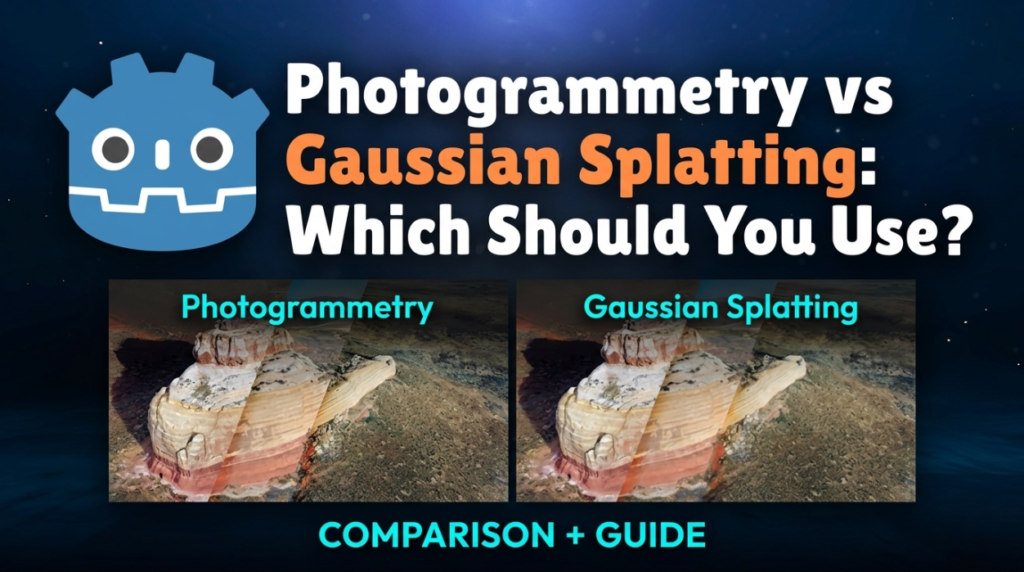
Photogrammetry and gaussian splatting both turn photographs into 3D. They produce fundamentally different things, and choosing wrongly wastes a lot of time.
The Core Difference
Photogrammetry produces a mesh — triangles with textures. Standard geometry you can import, edit, retopologise, UV, rig and ship.
Gaussian splatting produces a radiance field — millions of soft, view-dependent blobs optimised to reproduce the source images. It renders beautifully and has no topology at all.
One gives you an asset. The other gives you a view.
Where Splatting Wins
- Foliage and thin structures — trees, wires, railings, fences, which photogrammetry reduces to blobs
- Reflective and transparent surfaces — glass, water, polished metal
- Capture speed — generally more forgiving of imperfect capture
- Visual fidelity — the result usually looks more like the real place
Where Photogrammetry Wins
- You need a model — anything that will be edited, rigged, animated or optimised
- Game engine assets — meshes are what engines are built around
- Measurement — dimensionally accurate output for CAD or survey work
- 3D printing — you need watertight geometry
- Pipeline compatibility — every DCC handles meshes; splat support is still uneven
The Practical Rule
Ask what happens after capture.
If the answer is “someone looks at it” — a virtual tour, a location scout, a real estate listing, a background plate — splatting will look better and capture faster.
If the answer is “someone edits it” — an asset for a game, a prop to modify, a model to print — you need a mesh, so photogrammetry.
Using Both
Increasingly common in virtual production and environment work: splat the location for the background and fidelity, photogrammetry or hand-model the objects that need to be interacted with.
They are not competitors so much as different answers to different questions.
What About Cleanup?
Photogrammetry output is dense triangle soup and needs retopology before it is usable. MeshLab handles the repair stage, and free tools cover most of the rest — see our resources directory.
Splats do not get retopologised, because there is nothing to retopologise. That is either the advantage or the problem, depending on your job.