Insomniac Games has published a breakdown of the location-scanning trip it ran in Japan for Marvel’s Wolverine, and it is unusually specific about what a AAA reference trip actually costs in effort. The post is written by Principal Technical Artist Nathaniel Bell on the PlayStation Blog.
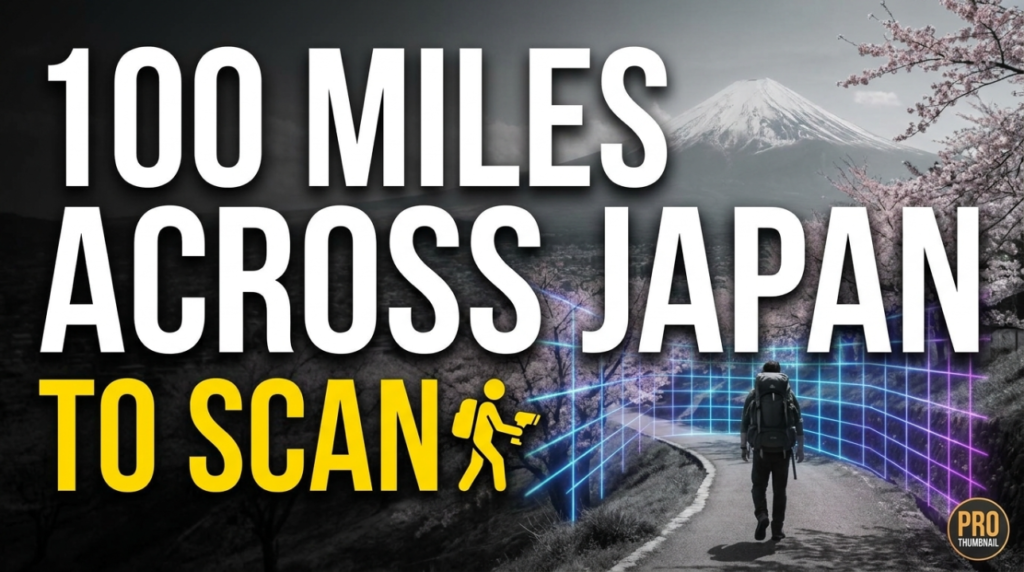
The numbers: a six-person team, a route running Tokyo to Joetsu to Tsumago-juku and Magome-juku to Kyoto and back to Tokyo, more than 100 miles walked with roughly 20 pounds of gear each. They came home with over 600 scans across four biomes, 189,589 photos and 5.6 TB of captured data. Casualties were two cables, a plastic case and the back of somebody’s phone.
What they actually captured
The four biomes break down like this:
- Mountains — snow, stone, bark, ground cover, and the way winter conditions change how those materials read.
- Bamboo forest — vegetation, plus what Bell calls the unique density and rhythm of the landscape.
- Urban — pavement, walls, street-level detail, public infrastructure, and the subtle signs of wear that make a city feel lived-in.
- Underground transit — the distinct materials and architectural patterns of a train station.
Notice what is not on that list. No hero props, no landmarks, no characters. This is a surface-and-structure library: the material that fills most of the screen and that nobody notices until it is wrong.
Scans become kits, not objects
The most transferable idea in the post is how the raw captures get used. Insomniac shows a scanned Japanese wall being turned into a reusable modular asset kit — not a single wall dropped into a level, but a set of pieces an environment artist can recombine. That reframes the whole trip. They were not collecting 600 assets. They were collecting the source material for a much smaller number of kits that can build a much larger amount of world.
If you scan anything yourself — even a phone-photogrammetry pass on the brick wall behind your flat — this is the part worth stealing. A scan of an object gives you one object. A scan processed into tiling surfaces, trim pieces and modular chunks gives you a set. The processing work is where the value is, and it is the work that gets skipped.
Why go, when scan libraries already exist
Bell’s answer is about observation rather than data. Being in Japan let the team see how structures are designed and built, how materials have actually weathered, and how local cultural detail shows up in an ordinary street. Firsthand research, he argues, gives artists a stronger foundation to build from.
That is a fair distinction. A CC0 concrete material from a scan library is geometrically correct and culturally nowhere. It will not tell you which surfaces get repainted, where the drainage goes, how signage is mounted, or which kinds of dirt accumulate and which get cleaned. Those decisions are what make an environment read as a specific place instead of a generic one, and they come from looking, not from downloading.
Who should care
Environment artists working in Blender, Unreal or Unity on anything set in a real place. The lesson scales down cleanly: pick one biome, capture surfaces and structures rather than objects, budget as much time for kit-building as for capture, and shoot plain reference photos alongside the scans — Insomniac took those on top of the 189,589 already counted, and reference is what survives when a scan does not solve.
Insomniac has not said how much of this material ends up visible in the shipped game, or which parts of Japan appear in it. The post is about method, and on that it is worth reading in full.