AI tools are arriving in architectural visualisation faster than in most 3D fields, and the reason is specific: archviz has more repetitive, well-defined tasks than character or VFX work.
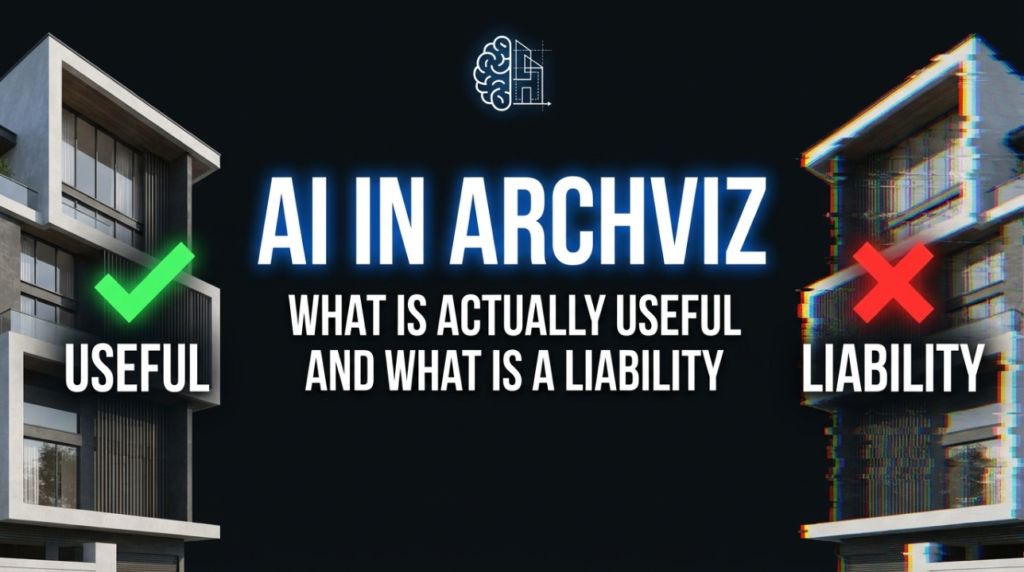
Where AI Is Genuinely Useful in Archviz
Mood and lighting matching. V-Ray 7 introduced AI Mood Match, which takes a reference photo and aligns a scene’s lighting and atmosphere to it. That is a real time saver — clients communicate in reference images, and translating a mood board into light setup is otherwise manual guesswork.
Entourage and set dressing. People, plants, vehicles and clutter are necessary and creatively uninteresting. Generated or library-based filling is a legitimate use.
Concept iteration. Generating facade or interior variations to show a client before committing modelling time.
Where It Is Not
Accuracy. Archviz sells a building that will be built. A generated image that invents a window, changes a proportion or hallucinates a material is worse than useless — it is a liability, because a client may approve something that cannot be constructed.
That is the fundamental limit. Generative tools optimise for plausibility; archviz requires correctness.
The Bigger Shift Is Not Generative
The change actually reshaping archviz workflows is real-time ray tracing — Chaos Vantage and V-Ray’s real-time viewport.
Adjusting lighting, materials and camera live in a client meeting, at final-frame quality, removes the render-send-wait-revise cycle entirely. That changes project economics more than any image generator.
See our piece on V-Ray going free for Blender.
What About Gaussian Splatting?
Relevant for site context. Capturing an existing location as a splat gives you photoreal surroundings to place a building into, far faster than modelling or photogrammetry.
But a splat is not geometry — you cannot edit it, and it will not light your building. Understand the distinction before planning around it: photogrammetry vs gaussian splatting.
The Realistic Position
AI in archviz is currently strongest at the parts nobody wants to do — entourage, variation, mood matching — and weakest at the part that defines the job, which is representing a real building accurately.
Tools that assist are being adopted quickly. Tools that generate are being adopted cautiously, and for good reason.