At the end of August, Blender Studio opened the entire OVERGROWN content gallery to everyone for a week — production logs, masterclasses, behind-the-scenes material, all of it, no subscription. That window has closed and the archive is back behind the studio subscription. The reason it was opened at all is the more useful story: the project has a hard subscriber deadline this month.
What OVERGROWN is
OVERGROWN is Blender Studio’s first feature film, after roughly twenty years of open short films. It is set in a post-human, robo-apocalyptic world reclaimed by nature and follows an unlikely family duo through it. Hjalti Hjálmarsson and Rik Schutte are co-directing. Like every Blender Studio project before it, the film is made in Blender and built in public: production files and documentation go out to subscribers as the work happens rather than as a post-mortem two years later.
The number on the page
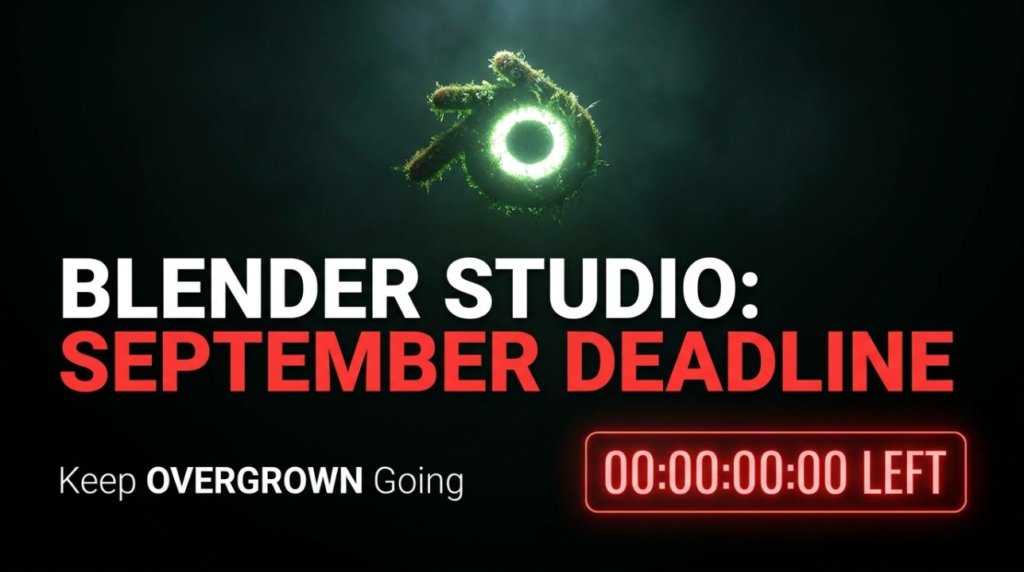
The OVERGROWN project page carries a live counter. At the time of writing it shows 5,983 subscribers against a target of 7,000, and states: “If Blender Studio reaches 7000 subscribers by the end of September, the story of OVERGROWN will continue.” Subscriptions start at €11.50 a month. The studio describes a 20/80 funding model — about a fifth of the budget from subscribers, the rest from external production financing — so the counter is less a crowdfund than a gate on the remaining eighty percent. A teaser is set for 14 September.
What is actually in the archive
Six production logs so far, each covering a phase of the work: the announcement and early visual development, then rigging, animation, handcrafted shading, water and effects, lighting, and most recently score and final compositing. Alongside them sits a masterclass on painterly shadows, published on 21 August, and documentation covering pipeline architecture, story tools and previs, rendering performance, asset and character creation, and mastering and delivery.
Why this matters in a game pipeline
Two reasons, and neither requires you to care about animated features.
The first is that Blender Studio’s open projects are where Blender itself gets stress-tested. A team builds a real production on the software, the places it breaks become bug reports and design work, and the fixes land in a later release for everyone. That loop has shaped a large amount of what is in Blender today. If you use Blender in an Unreal or Unity pipeline, what this studio is able to attempt next is not unrelated to your toolset.
The second is the documentation itself. Public, contemporaneous accounts of how a full film pipeline is wired together on open tools are rare — most studios release a breakdown reel and nothing behind it. The painterly and non-photoreal shading material is the part that travels furthest into games, because it is the same problem stylised game art keeps running into: making hand-painted lighting hold up under a camera that moves.
Who should care
Blender users doing stylised or NPR work, technical artists who want to see how a small team structures a production rather than guess at it, and anyone teaching a pipeline course who has been short of real examples. If you were already intending to look at it, the date on the project page is the end of September.
Details and the current counter are on the OVERGROWN project page, and the free week was announced in Blender Studio’s Open Doors Week post.