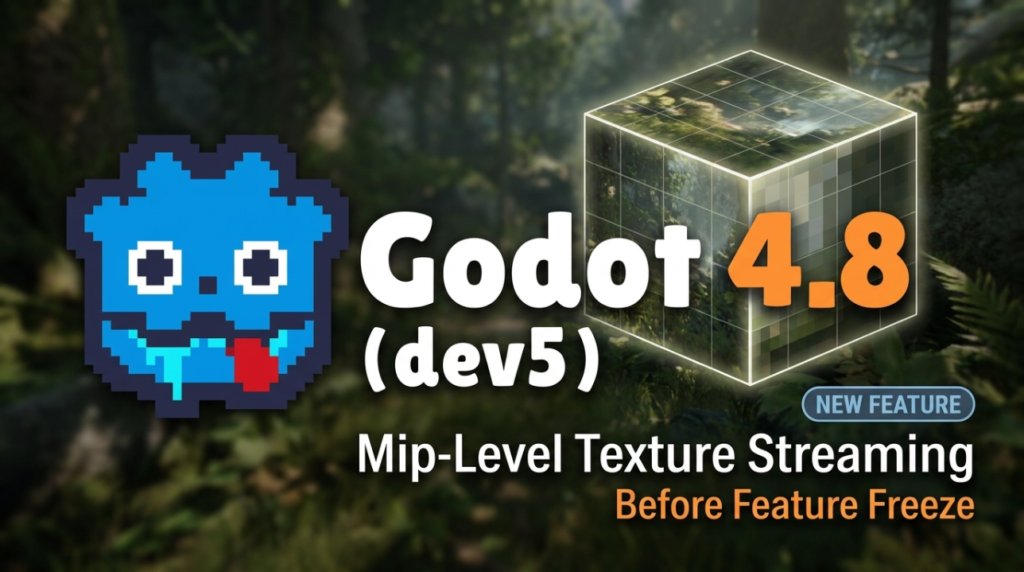
Godot 4.8 dev 5 landed on September 10, carrying 183 fixes from 78 contributors. It is one of the last snapshots before 4.8 hits feature freeze later this month, which makes it a reasonable preview of what the release will actually contain. The headline addition is mip-level texture streaming — a feature Godot users have been asking for since the 4.x line began.
Texture streaming, finally
Implemented by Trevor Davenport, the new system loads texture mipmaps on demand based on camera distance rather than holding every mip level of every texture in VRAM for the entire scene. Godot’s own description is a significant reduction in texture VRAM requirements, particularly for 3D titles with large open worlds.
It is opt-in at two levels. You enable streaming in project settings, which requires an editor restart, then import the textures you want streamed as the new Texture2D Streamed type. Each streamed texture takes its own minimum and maximum resolution overrides, so you can hold a hero asset at full resolution while letting background props drop aggressively.
The two-level opt-in matters more than it sounds. Streaming systems that apply globally tend to produce visible pop-in on the assets you cared about most, and the usual fix is a per-asset exception list bolted on afterwards. Godot shipped the exception mechanism as part of the feature.
The alpha fix that ships alongside it
A second import change from Kasper Arnklit Frandsen preserves alpha test coverage: textures keep their alpha data even when falling back to scaled-down equivalents. If you have ever watched foliage cards, chain-link fencing or grate textures dissolve into mush as the camera pulls back, that is the problem this solves. Alpha scissor materials degrade badly through naive mip generation because averaging an alpha channel destroys the coverage the scissor threshold depends on.
Pairing that fix with streaming in the same snapshot is sensible sequencing — a streaming system that aggressively swaps in lower mips would have made the alpha problem considerably more visible.
Editor and everything else
Jayden Sipe reworked the 2D toolbar for consistency with the recent game view changes, with the stated focus on usability and clarity. The snapshot also adds 2D information and frame time panels, bringing 2D closer to the profiling visibility 3D already had.
Smaller changes worth knowing about:
BoneSpreader3Dhas been renamed toBoneSpaceAdjuster3D. Check your rigs if you touched it.RenderingDevicecompilation can now be disabled, which matters for minimal or headless builds.- Text scene files support metadata.
- A unified property mapping for
GDTypereclaims roughly 12MB of RAM. SpinBoxgains aformatproperty; the older prefix and suffix properties are deprecated.- Input device orientation is now available as a quaternion.
- Linux builds integrate with Feral GameMode.
Godot lists no known issues introduced by this snapshot and documents no breaking changes beyond the node rename and the SpinBox deprecation.
Who should install it
This is a development snapshot, not a release candidate. Do not move a shipping project onto it. But if you are building anything 3D in Godot at a scale where VRAM is your ceiling, this is the snapshot to copy your project into and profile, because the memory numbers you measure here are close to what 4.8 will give you. Feedback filed before the freeze still has somewhere to go; feedback filed after it does not.
Standard and .NET builds are available for Linux, macOS and Windows, alongside the web, XR and Android editors. Full details are in the Godot dev snapshot announcement.