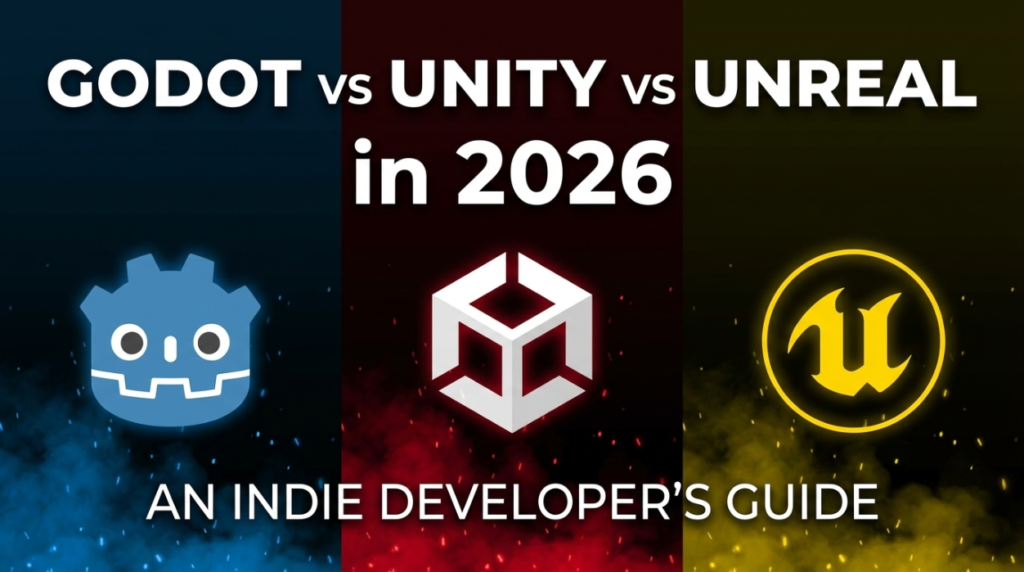
Choosing an engine is the decision indie devs agonise over most and change least often. Here is a practical comparison for 2026, focused on what actually matters when you are small: cost, learning curve, and what happens when your game succeeds.
Which Engine Is Genuinely Free?
Godot is the only one that is free in every sense. MIT licensed, no royalties, no revenue thresholds, no seat fees, forever. You can ship a million-selling game and owe nothing.
Unreal is free to develop with and charges a royalty once a game passes a revenue threshold. Unity has a free Personal tier with a revenue ceiling and paid tiers above it. Both are workable, but only Godot has genuinely zero strings.
Which Is Easiest to Learn?
Godot, for most beginners. It is a small download, opens instantly, and GDScript reads like Python. Its documentation is genuinely one of the best in the industry.
Unity is second, with the largest tutorial ecosystem anywhere, which matters more than people admit when you are stuck at 2am. Unreal is the steepest climb, though Blueprints let you build real gameplay without writing code.
Which Looks Best Out of the Box?
Unreal, and it is not close. Lumen, Nanite and its material system give you high-end visuals with less work than anywhere else. If you are making a realistic 3D game and visual fidelity is the selling point, this is the reason to accept the complexity.
For stylised, low-poly or 2D work, that advantage mostly disappears, and Godot or Unity will get you there faster.
Which Is Best for 2D?
Godot. Its 2D engine is a true 2D renderer rather than 3D with the camera locked, and it shows in both workflow and performance. Unity is capable but heavier. Unreal is the wrong tool for most 2D projects.
Which Has the Best Asset Ecosystem?
Unity, by volume. The Asset Store has a package for almost everything, which can genuinely shorten a solo project by months. Unreal’s Fab is strong for high-end art. Godot’s ecosystem is the smallest, though growing quickly, and its open-source culture means more free tooling.
Which Should You Pick?
- Complete beginner, small 2D or 3D project — Godot.
- Realistic 3D visuals, cinematic ambitions — Unreal.
- Mobile, VR, or you want the biggest asset and tutorial ecosystem — Unity.
- You never want a licence surprise — Godot.
Whichever you choose, your art pipeline can stay the same. Blender exports cleanly to all three, and our asset library covers tools for each. Licence terms change, so verify current pricing on each engine’s official site before committing to a commercial project.