Text-to-motion has been one of the more quietly impressive corners of AI research: type “a person jogs then stops and waves” and get back a 3D skeletal animation. The catch has always been hardware. NVIDIA’s Kimodo, the model behind much of this work, is reported to need around 17 GB of VRAM per generation.
On 22 August 2026, Richard Palethorpe announced kimodo.cpp, a port of the model to C++ and GGML — the same framework that made large language models runnable on laptops via llama.cpp. It generates motion on CPU or Vulkan, which also means it is no longer tied to NVIDIA hardware.
What Kimodo Actually Is
Kimodo (Kinematic Motion Diffusion) comes from NVIDIA’s research labs. It generates 3D skeletal animation from a text prompt, and can also be steered with constraints: full-body pose keyframes, end-effector positions, 2D paths and waypoints. It was trained on hundreds of hours of commercially licensed optical motion capture.
The original repository has drawn thousands of stars, and it supports several skeletons — SOMA, SMPL-X, and the Unitree G1 robot rig, which hints at how much of this research is aimed at robotics as much as animation.
What the C++ Port Changes
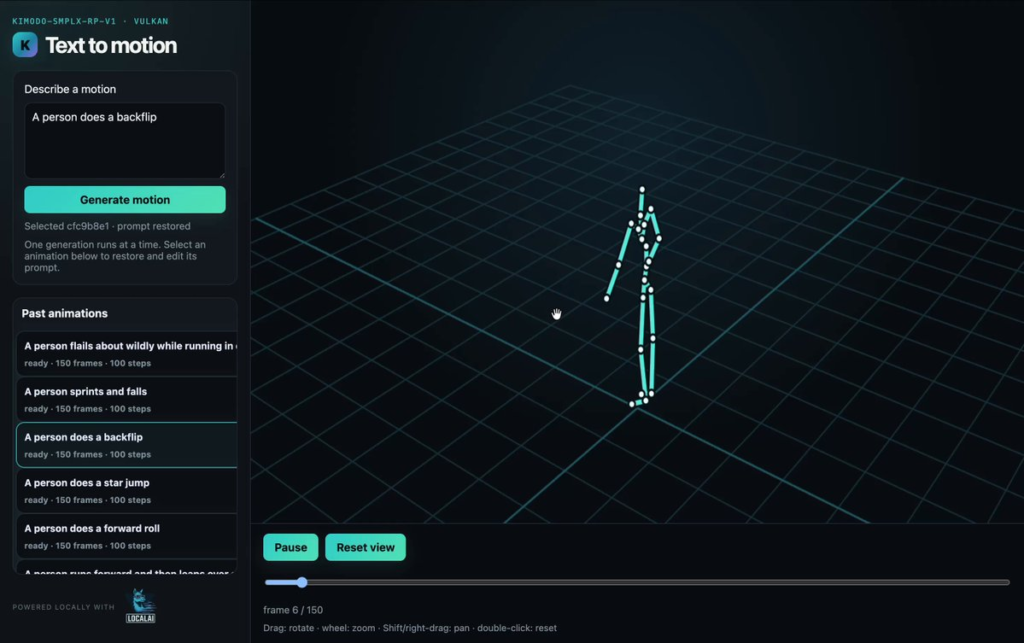
Accessibility, mainly. The port handles GGUF loading, safetensors conversion and DDIM sampling, exposes a C API, and ships a small local browser demo with prompt history. Everything runs offline.
It is also honest about being early. Constraints, the SOMA and G1 skeletons, GLB export and quantised models are all listed as not yet implemented. There is no Blender or Maya integration and no FBX output — you get SMPL-X22 rotation data through a C API, and building it requires Nix and CMake.
Should Animators Care Yet?
Not for production work today. This is infrastructure, not a finished artist tool, and the weights are gated behind Hugging Face licences for both the SMPL-X checkpoint and the Llama base model.
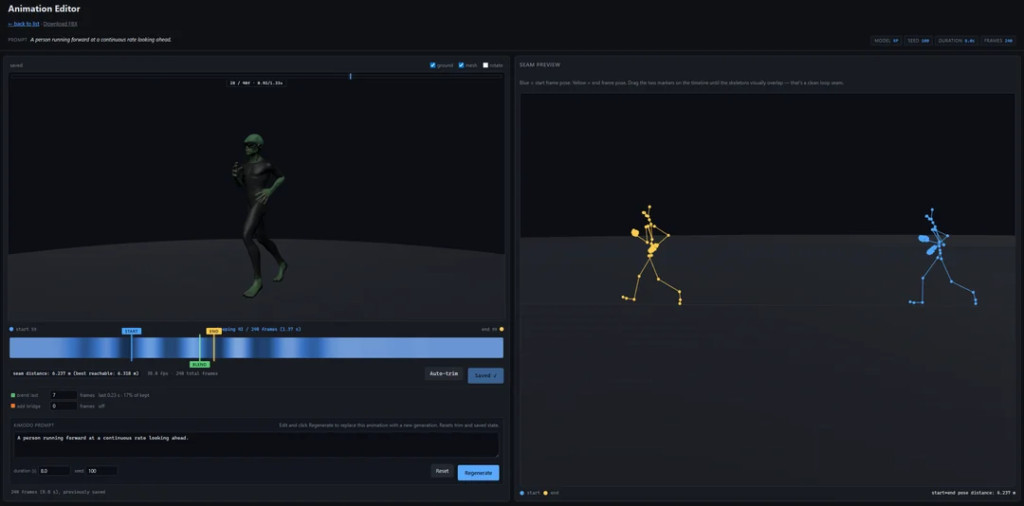
What makes it worth watching is the pattern. Wrappers have already appeared around the original Kimodo turning it into game-dev workflows — upload a rigged FBX, prompt for a motion, get a loopable clip for Unity or Unreal. Those tools have been honest about the limits too: prompt handling is not literal, the training data is academic mocap rather than game animation, and every generation should be treated as a draft to curate rather than a finished take.
Once local inference is solid, that wrapper layer is where the artist-facing tools will appear. The same thing happened with image generation and with local LLMs.
The Bigger Picture for Solo Animators
Between video mocap tools like BlendCap and text-to-motion models like Kimodo, the two cheapest paths to character animation are both converging on the same idea: generate a rough performance fast, then spend your time polishing rather than blocking.
Neither replaces an animator. Both change where the hours go. For a full comparison of what is available now, see our guide to AI motion capture tools in 2026.