
NVIDIA’s Kimodo is a kinematic motion diffusion model: you describe a movement in plain language and it generates a 3D skeletal animation. kimodo.cpp is a community port of that model to C++ and GGML — the same framework behind llama.cpp — which means it can run on ordinary hardware instead of requiring a large NVIDIA GPU.
It was released on GitHub in August 2026 by Richard Palethorpe and the LocalAI team, who have been steadily porting AI inference models to C++ backends.
Why This Release Matters
The original Kimodo implementation is demanding: reports put it at roughly 17 GB of VRAM per generation, which rules out most consumer machines. The C++ port generates motion on CPU or Vulkan, and Vulkan means it is not locked to NVIDIA hardware. The text encoder processes in eight-layer chunks by default, and you can tune VRAM use with an environment variable.
That shift — from datacentre GPU to a laptop — is the interesting part. Text-to-motion has existed for a while; being able to run it locally and offline has not.
What It Does Right Now
- Accepts a plain-text prompt or a precomputed LLM2Vec embedding
- Generates unconstrained SMPL-X22 local rotations and root translations
- Runs on CPU or Vulkan, with parity tests between the two
- Ships GGUF loading, safetensors conversion, DDIM sampling, and C/C++ APIs
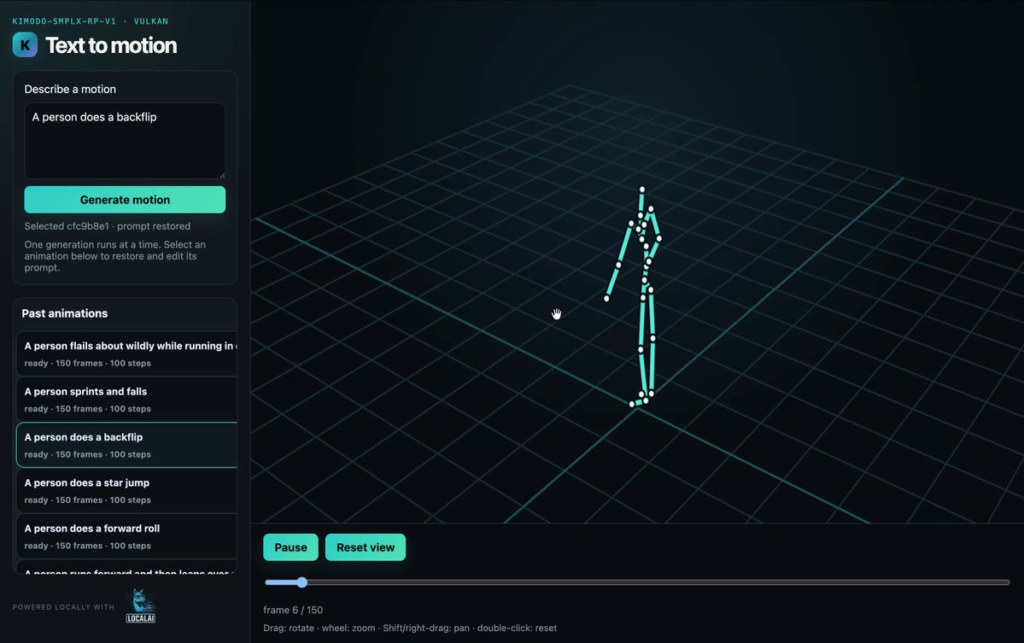
- Includes a local browser demo with prompt history, served on localhost
What It Does Not Do Yet
This is an early release — five commits at the time of writing — and the README is refreshingly direct about the gaps. Constraints, the SOMA and Unitree G1 skeletons, GLB export and quantised models are all still unimplemented.
Practically, that means there is no Blender or Maya integration, and no FBX or GLB output. You get raw SMPL-X rotation data through a C API. Getting that onto a production rig is work you do yourself.
Who This Is Actually For
Developers and technical artists, not general animators. Building it requires Nix and CMake, and the weights are gated: you need to accept the Hugging Face licences for the SMPL-X checkpoint and the Llama base model before downloading them.
If you want text-to-motion you can use in a DCC today, this is not that tool yet. If you want to build motion generation into your own pipeline or engine without a cloud dependency, it is a significant piece of groundwork.
Developer: LocalAI (port) · NVIDIA (original model) · Price: Free / open source · Platform: C++ / GGML, CPU or Vulkan
Comparing your options? See our roundup of AI motion capture tools.
For the Blender-ready version, see the text-to-motion in Blender guide, and our motion capture comparison.