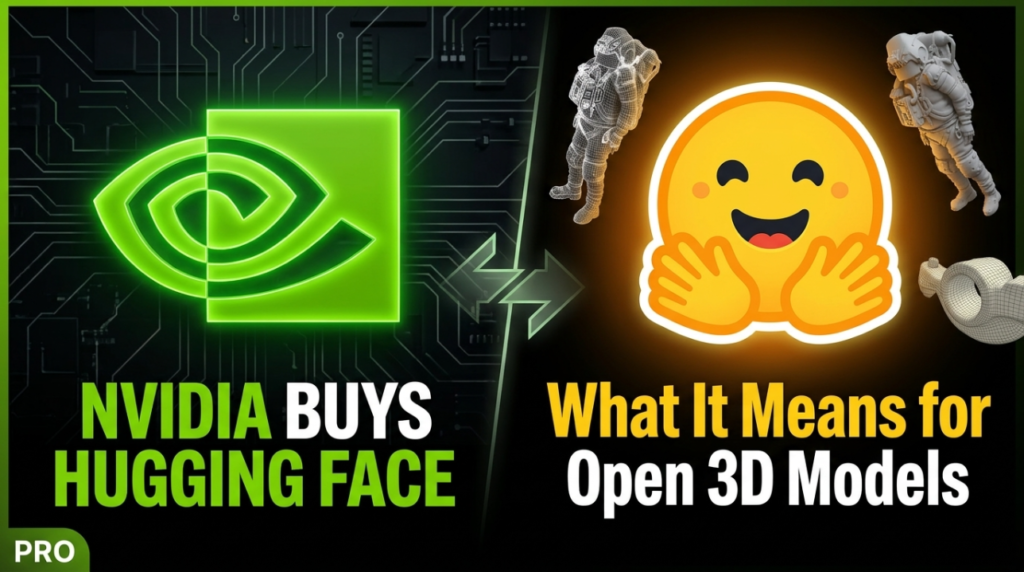
NVIDIA announced on 3 September 2026 that it has agreed to acquire Hugging Face for approximately $12.9 billion. The announcement is written by CEO Jensen Huang and published on the NVIDIA Blog.
If you have never opened Hugging Face on purpose, you have almost certainly used it anyway. It is the default distribution point for open model weights, which makes it the place most of the AI tooling now sitting in 3D pipelines quietly fetches its files from. Install a ComfyUI workflow, an add-on that does AI texturing, or a local image-to-3D generator, and the multi-gigabyte download that follows is usually coming off that hub.
The scale involved
NVIDIA’s post puts numbers on it: more than 18 million developers, researchers and creators use the platform, which hosts over 3 million models, 500,000 datasets and 1 million applications. More than 200,000 companies use it to discover, evaluate, customise and deploy AI.
NVIDIA is not a stranger to it either. The same post notes the company has already released more than 500 models and over 250 open datasets there.
What NVIDIA says will not change
The commitments are stated plainly. “Hugging Face will remain an open platform for the entire AI ecosystem,” the post says, and NVIDIA pledges to keep supporting open source and open weight models from every model builder. It frames developer choice as staying intact: “Developers will choose the models they want, the frameworks they want, the clouds and inference service providers they want and the computing platforms they want.”
Hugging Face’s founders — Clem, Julien and Thomas — continue to lead the company, and the platform keeps its branding. NVIDIA says it will scale the platform, strengthen its infrastructure and expand access to AI for developers and institutions worldwide.
Why a 3D artist should care
- It is your download path. Open image-to-3D generators, video models, motion-from-video models and texture models are distributed as weights on the hub. If access rules, rate limits or licence presentation change there, it reaches your machine before it reaches any headline.
- Open weights are what keep this stuff local. The reason you can run an AI tool offline next to Blender at all is that somebody published downloadable weights instead of an API key. The multi-cloud, multi-accelerator language in NVIDIA’s post is the part worth holding them to: a hub optimised only for one vendor’s hardware would narrow what runs on the GPU you already own.
- Consolidation changes bargaining power, not just ownership. The company that makes the GPUs now also owns the shopfront where the models that need those GPUs are distributed. That is not automatically bad for artists, and NVIDIA’s open-model track record is real. It does mean one fewer independent party in a chain most of us depend on.
What is not answered yet
NVIDIA’s announcement does not state when the deal is expected to close or what regulatory conditions apply. It also says nothing specific about hosting costs, storage limits or how the free tier is funded going forward — the questions that actually decide whether small, independent model authors keep publishing there. Those are the details to watch over the next few months, not the headline number.
What to do about it
Nothing urgent. But if part of your pipeline depends on a specific set of open weights, this is a reasonable prompt to keep local copies of the model files you actually use, and to write down their licences somewhere you can find them again. That is good practice whoever owns the hub. It is just easier to remember in a week when the answer to “who owns it” has changed.