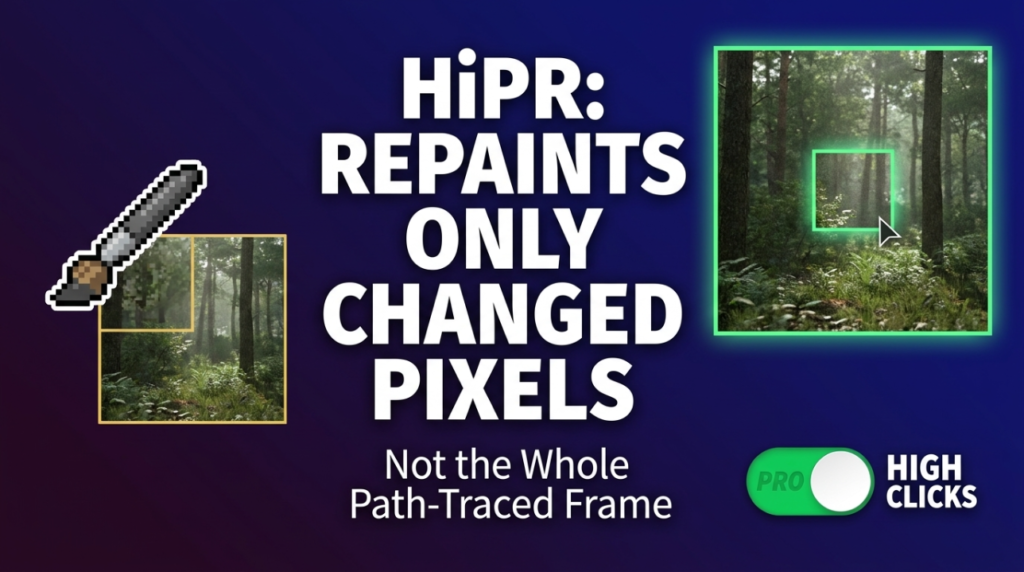
Interactive path tracing has one recurring failure mode: you nudge a light, and the entire image starts over from noise. Every pixel gets recomputed, including the ninety percent of the frame your edit could not possibly have touched. HiPR — Hierarchical Progressive Rendering — is a technique from a University of Utah team that proposes a different rule. When something in the scene changes, repaint only the pixels that actually change, and repaint them in order of how much they matter.
What was published
The work is by Rafael Padilla, Andrew W. Tate, Dhruv Ram and Cem Yuksel at the University of Utah, presented at SIGGRAPH Real-Time Live! 2026 with the full write-up on arXiv as HiPR: Hierarchical Progressive Rendering for Immediate Feedback. The core idea, in the authors’ framing, is to amortise rendering cost by organising pixels into a hierarchy of light-path dependencies that spreads outward from the changed elements, then prioritising those pixels by perceptual impact.
How it decides what to draw
Three stages. First, a visibility pass fires a single primary ray per pixel to build a G-buffer of object identity and depth, which marks the tiles containing whatever you just moved, retextured or relit. Second, path tracing runs on those directly affected tiles — and while it traces, it projects each bounce vertex back into screen space. That is how the method finds the tiles you did not touch but that your edit still changes: the reflection of the moved object, the bounce light it throws onto the wall behind it. Each discovered tile accumulates a weight built from path throughput, material lobe type, light transport classification and bounce depth. Third, tiles are sorted by that weight and rendered in descending order, with the undiscovered remainder rendered eventually so the image still converges unbiased.
That last detail is the one worth holding on to. This is not a denoiser or a temporal trick that quietly bakes in error. The final converged frame is the correct frame; the technique only changes the order in which you get there.
Why it matters if you work in Blender or Unreal
Look dev is the obvious case. The reason artists flip to EEVEE or Lumen for the feel pass and only path-trace at the end is that a path-traced viewport punishes iteration: the cost of a tweak is the cost of the whole frame, every time. Under this scheduling, the cost of a change scales with the size of the change. Adjusting one roughness value should not cost the same as reframing the camera, and here it does not.
The paper points at two other applications. One is virtual production review, where several people are changing things live and everyone is waiting on the same frame. The other is attention-guided rendering, where priority order is driven by where the viewer is looking or where gameplay is happening, rather than by what was edited.
The caveats
This is a Real-Time Live! demonstration, and the paper publishes no frame times, no comparisons and no benchmark data. How much faster it actually is remains unanswered. The reference implementation is also renderer-architecture work rather than something you install: Vulkan, inline ray tracing inside a single compute-shader megakernel instead of the standard ray tracing pipeline, hardware BVH traversal, and OpenPBR BSDF materials keyed by object ID.
So nobody is downloading HiPR this week. It matters as a direction. If you build renderers or pipeline tools, or you simply want to understand why interactive path tracing might stop feeling like a slideshow, the paper is a short read and the three-stage breakdown is the whole argument.