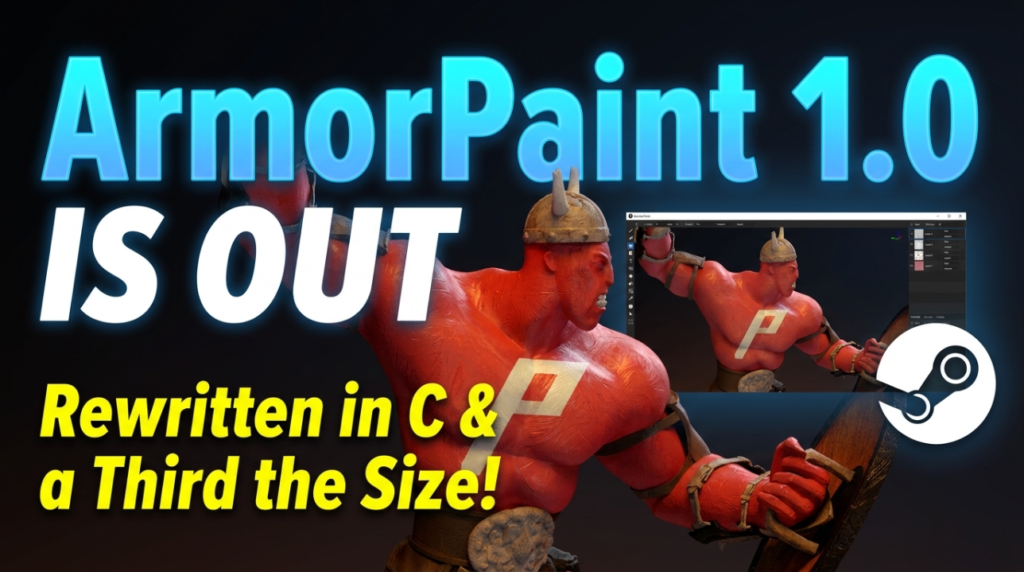
ArmorPaint has tagged a 1.0 release. The build went up on the project’s GitHub repository on 3 September as tag 26.09, titled simply “1.0”. It closes out a development run whose first entry on the project’s own release notes page is dated 2017.
ArmorPaint is a standalone 3D PBR texture painting application — the same job Substance 3D Painter does, in a program you install once and whose full source sits in public. It has been usable for years. What is new is that the developer is now willing to call it 1.0, and the work that got it there was largely structural.
The rewrite is the headline
According to the release notes on armorpaint.org, ArmorPaint has been rewritten in C and the V8 JavaScript dependency has been removed entirely. The rendering layer moved to Direct3D12, Vulkan and Metal, with shaders going through the Kongruent compiler.
The figures published alongside that rewrite are the part worth reading twice:
- The program dropped from 9.3 MB to 3.7 MB
- Loading an 800 MB
.objwent from 7.3 seconds to 4.1 seconds - Memory use on that same load fell from 2.7 GB to 1.12 GB
A 3.7 MB texture painter is an unusual thing in 2026. More practically, halving the memory cost of loading a heavy mesh is what decides whether you can keep the painter open next to Blender and a browser on a 16 GB machine, or whether you are closing things to make room.
What is new to actually use
On top of the rewrite, 1.0 adds a grid snap option, a gizmo tool, a black theme, a text texture node, UV unwrapping inside the app, and fake subsurface scattering in the pathtracer. The notes also list updated plugins for Unreal Engine, Unity and Blender, plus work on the iPad and Android builds.
UV unwrap is the quiet one. Being able to fix a bad island without bouncing back to your DCC removes a round trip that, in practice, is where most texturing sessions lose their momentum. The gizmo and grid snap point the same direction: fewer reasons to leave the app mid-pass.
How you get it
This is the part people get wrong about ArmorPaint, so it is worth stating plainly. The source is public on the armory3d/armorpaint repository and you can build it yourself. The compiled binaries the project distributes are paid. The README puts it directly: “Distributed binaries are paid to help with the project funding. All of the development is happening here in order to make it accessible to everyone.”
So it is open source, but “free” depends on whether you are willing to compile. That is a real fork in the road if you are assembling a no-subscription pipeline, and it is worth knowing before you budget it in.
Who should care
If you are on a Substance subscription and happy with it, 1.0 will not move you. Substance still has the deeper smart material library and the studio integrations. But if you are an indie, a student, or a solo artist who has been putting off the texturing question, a 1.0 tag on a self-hosted, source-available painter with Blender, Unreal and Unity plugins changes the calculation — mostly because it signals the project is stable enough to build a habit around.
For where it sits against the rest of the field, see our rundown of Substance Painter alternatives in 2026 and the browser-based Mixos.