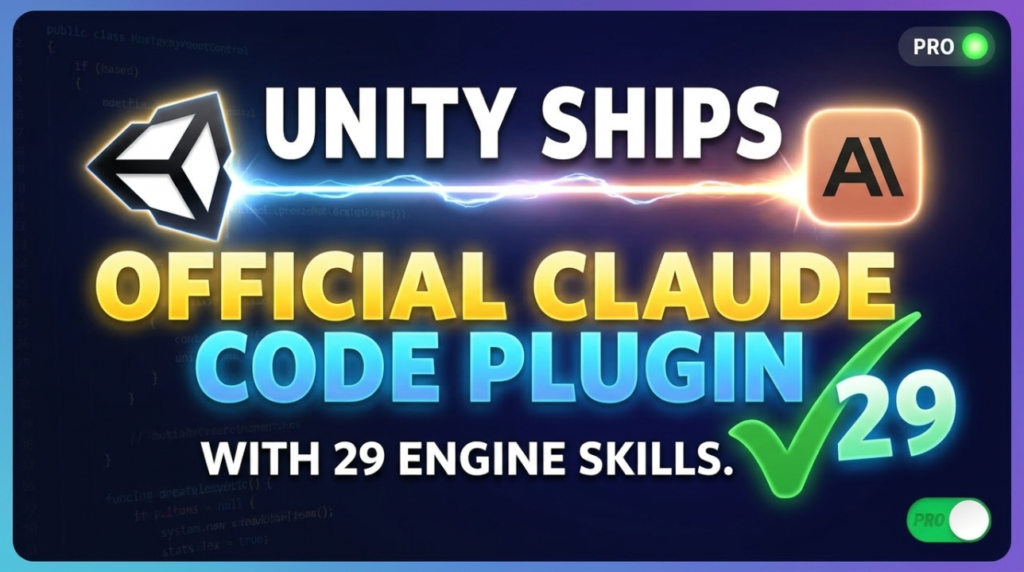
Unity released an official plugin for Claude Code on September 9, announced by Rachel Zhao, Unity’s Director of AI Products. It bundles three separate things into a single install: 29 Unity-authored skills, the Unity CLI, and live Editor control through Unity’s MCP server.
Community-built Unity MCP bridges have existed for a while, and plenty of people already point coding agents at their Unity projects. What changes here is authorship. A skill in this plugin is a scoped procedure written by Unity describing how Unity expects a specific job to be done — so the agent follows a documented path instead of reconstructing one from whatever forum threads and outdated tutorials it absorbed during training.
What the 29 skills cover
Unity groups them into eight categories. The spread tells you who the plugin is aimed at:
- UI and text:
/ui,/ui-uitk,/ui-ugui,/ui-imgui,/optimize-text-mesh-pro - 2D and sprites:
/2d-pixel-perfect,/sprite-editor,/manage-sprite-atlas, plus three tilemap and rule-tile skills - Graphics:
/urp-postprocessing,/shader-graph-create-custom-node,/validate-urp-render-graph-renderer-feature - Audio:
/audio-setup-mixers,/optimize-audio,/setup-vivox-voice-chat - Scene and gameplay:
/initialize-ai-navigation,/physics-3d-collision - Monetization and live ops:
/implement-in-app-purchases,/levelplay-unity-integration,/build-live-game - Multiplayer, platform and localization:
/setup-multiplayer-services,/optimize-web,/localization
That is a list of chores, not a list of creative work. Sprite atlases, rule tiles, render graph validation, mixer routing, IAP plumbing — the setup steps nobody enjoys and everybody gets subtly wrong the first time.
The CLI skill is the interesting one
Most of the skills are knowledge. /unity-cli is capability. Unity describes it as driving Unity from the terminal, including a live Editor: creating and modifying GameObjects, editing scenes and assets, inspecting the hierarchy, and running C#. It also handles editor installs, licences, builds and logs. That is the difference between an agent that can tell you how to set up a URP renderer feature and one that opens your project and does it.
Installing it
/plugin marketplace add Unity-Technologies/unity-agent-plugin
/plugin install unity@unity-agent-plugin
Your Claude Code install needs to be recent enough to have the /plugin command; check with claude --version and update if the command is not recognised. You can scope it per user, per project or per repository. Unity’s documentation covers the variations.
What Unity admits it does not do
The documentation is unusually frank. Unity notes the plugin has limited value for simple uGUI work compared to doing it by hand, and that on a current-generation model the plugin mostly supplies correctness rather than capability — the model could build many of these features without it, just less reliably. /new-unity-project scaffolds a project but explicitly does not scaffold gameplay code.
Neither the announcement nor the docs page states which Unity Editor versions are supported, which is the first thing most studios will want to know before wiring this into a production project.
If you already work in Claude Code and your Unity time is dominated by configuration rather than design, this is worth twenty minutes. If you were hoping an agent would write your gameplay systems, Unity is telling you plainly that this is not that. Unity says it plans to bring the plugin to other coding agents later in 2026. Full details are in Unity’s announcement post and the Unity plugin documentation.