Retopology is the part of the pipeline nobody enjoys and everybody pays for — either in hours, or in a ZBrush or Exoside licence. AutoRemesher 1.1 is out, and it keeps chipping away at the reason those licences exist.
It is free, MIT-licensed, cross-platform, and developed by Jeremy Hu, the author of Dust3D.
What Changed in 1.1
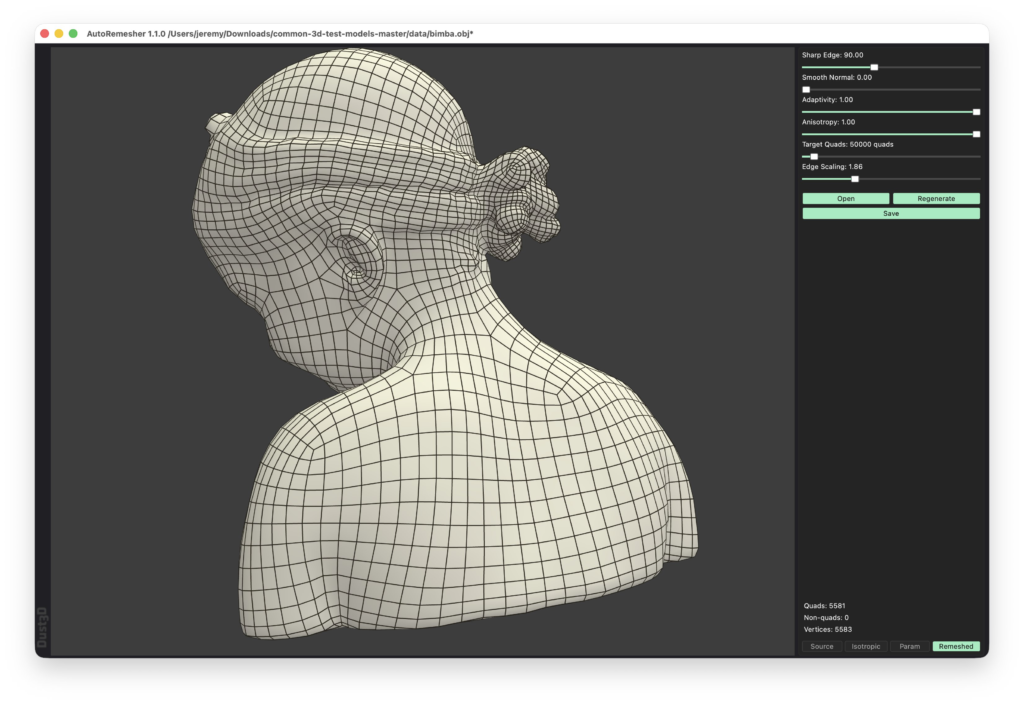
The headline is architectural: the Geogram dependency has been replaced with a native quad parameterizer. That is the component deciding how quads flow across a surface, so rewriting it changes output quality rather than just performance.
Alongside it, the release adds anisotropic quad sizing — quads can now stretch along the direction of flow instead of staying uniformly square, which is closer to how a human retopologises a limb or a fold. Extracted quads are also smoothed and projected back onto the input mesh, reducing the shrinkage that plagues automatic remeshers on detailed sculpts.
Two more changes deserve attention. Non-manifold mesh remeshing is fixed, which is the single most common failure mode when feeding in scan data. And the new previews show singular vertices and extracted connections, so when edge flow goes wrong you can see where the poles landed instead of blindly nudging sliders.
The Licence Is the Real Story
AutoRemesher moved from GPLv3 to MIT at version 1.0 earlier this year, after the developer reimplemented the dependencies that made MIT impossible. MIT permits commercial use, modification and redistribution.
That is what separates this from most free 3D tooling. You can ship assets made with it, build it into a studio pipeline, or fork it into your own product. ZRemesher and Quad Remesher cost money per seat; QuadriFlow is free but ships inside Blender and is widely considered unreliable on organic shapes.
How Good Is It Actually?
Reported comparisons put it ahead of QuadriFlow on organic models, with better edge flow and fewer artefacts, and in the neighbourhood of the commercial tools on output quality. It is slower than Instant Meshes but holds global topology consistency better. One user measured roughly 43 seconds on a 183,000-face mesh.
The realistic assessment: excellent for scans, background assets, kitbash cleanup and AI-generated meshes. Not a replacement for hand retopology on a hero character whose deformation has to be perfect. That has been true of every auto-remesher ever made, including the expensive ones.
Getting It into Blender
It is a standalone app, but two community bridges exist. Adrien Rouquié’s AutoRemesher Bridge round-trips a temporary OBJ out of Blender and back. A separate fork by Jake Blakeley packages it as a native Blender extension for 5.1+ (with builds for 4.2 LTS to 5.0), adding a DynaMesh-style shell welding preprocess and running the remesh in its own process so a crash cannot take Blender with it.
Neither is official, which is worth knowing before it becomes load-bearing in your pipeline.
Why This Keeps Mattering
Blender’s own QuadriFlow implementation has not meaningfully improved in years. An MIT-licensed remesher producing better results is exactly the kind of project that could be upstreamed — people have been suggesting it since the 2020 alpha.
For now it is a free download that removes a genuine cost from small studios and solo artists. See more free modelling tools in our retopology and modelling roundup or the full 3DxDEV Library.