Short answer: probably not yet. Blender 5.3 is a regular release, not LTS — and 5.2 LTS is supported until July 2028. If you are shipping client work or running a studio pipeline, staying on 5.2 is the correct call.
Upgrade if you are a solo artist who wants new tools and can tolerate a shorter support window. The rest of this covers what you would actually be getting, and what to check first.
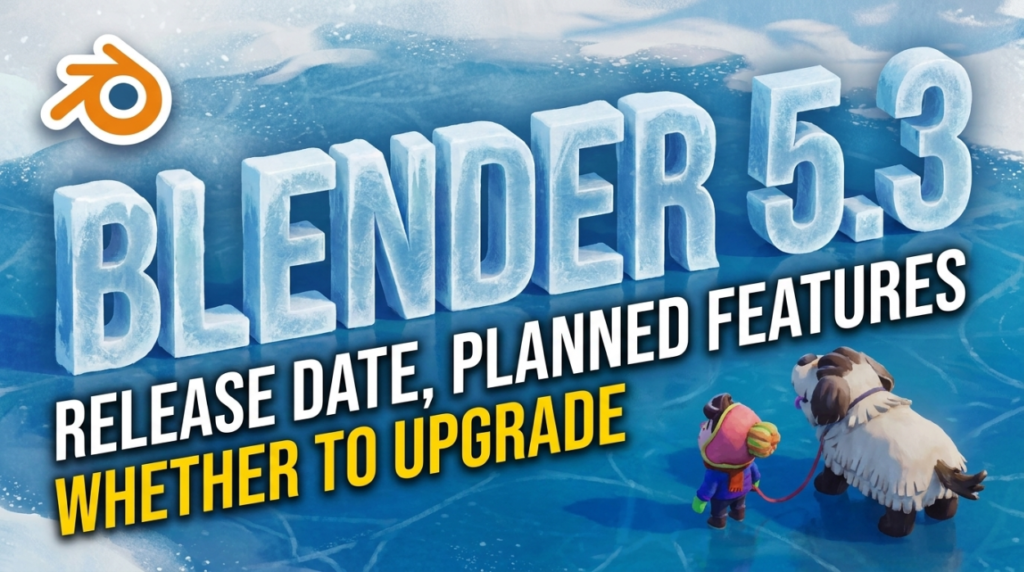
Blender 5.3 is in alpha until 30 September 2026, with release targeted for November. Search interest is already climbing, so here is what is actually planned — and how much of it you should count on.
One caveat up front, and it is the Blender Foundation’s own: roadmap items are targets, not promises. Its 2026 post openly acknowledged that previous roadmaps missed items due to over-scoping, unclear designs and shifting priorities. Treat everything below as intent until it appears in the final release notes.
When Does Blender 5.3 Release?
- Alpha — until 30 September 2026
- Release — targeted November 2026
- Current stable — Blender 5.2 LTS, released 14 July 2026, supported until July 2028
Blender ships roughly every four months, so this is a normal cadence release rather than a major architectural jump.
The Features Worth Watching
From the Foundation’s 2026 roadmap, these are the projects targeted at the 5.x cycle:
- Layered textures — long-requested, and the item most likely to change day-to-day texturing work in Blender.
- Animation layers — non-destructive animation adjustment, standard in Maya and a genuine gap in Blender.
- Non-photorealistic rendering — native NPR tooling, which currently requires add-ons or hand-built shader setups.
- A new hair solver
- Video sequencer improvements — GPU support, new effects, media bins, ripple and three-point editing.
- Cycles texture cache — relevant to anyone hitting VRAM limits on heavy scenes.
- 3D brush texture workflow and an online asset library.
Which of These Actually Matter?
Two stand out for most users.
Animation layers, because non-destructive adjustment changes how you work rather than adding a feature you occasionally use. Being able to layer a correction over existing motion without destroying it is how animators in other packages have worked for years.
Native NPR, because stylised and anime-styled rendering is one of the fastest-growing areas in Blender, and it currently runs on community add-ons and hand-built node setups. First-party support would consolidate a lot of fragile workflows.
Should You Install the Alpha?
Not for production work. Alpha builds crash, features change, and files saved in a newer version cannot be opened in older ones.
If you want to test, install it alongside your stable version rather than over it, and never open your only copy of a project file in an alpha build.
Should You Upgrade From 5.2 LTS?
If you are on a deadline or working in a studio pipeline, no. 5.2 is LTS and supported until July 2028 — that is the version to stay on if stability matters more than features.
5.3 is a regular release, not LTS. It gets bug fixes for a shorter window. For solo artists chasing new tools, that is a fine trade. For anyone shipping client work, LTS exists precisely so you do not have to make that decision every four months.
What to Do Now
Nothing urgent. Stay on 5.2 LTS, watch the release notes as alpha closes on 30 September, and check whether the add-ons you rely on have been updated before you move.
That last point is the one people forget — a new Blender version routinely breaks add-ons, and the fix arrives on the developer’s schedule, not yours.
More Blender resources in the 3DxDEV Library.