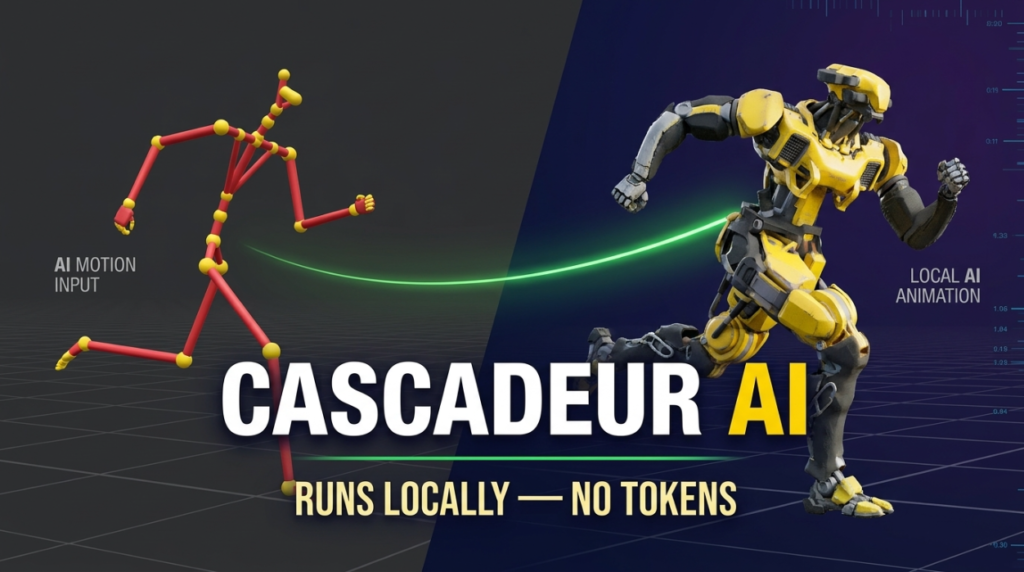
A post about Cascadeur has been circulating claiming it “obliterated token-based billing for AI animation” — unlimited local generation, no credits, no cloud queue.
The underlying point is correct and genuinely important. The framing is not: Cascadeur never had token billing. It has been local desktop software since 2019. Nothing was obliterated — it simply never adopted the model everyone else did.
That distinction matters, because the real story is better than the hype version.
The Cloud Tax on Iteration
Most AI animation runs in the cloud and bills per generation. DeepMotion sells credits. Plask and Move.ai sell subscriptions with limits. Every experiment has a price attached.
That quietly changes how you work. When a test costs money, you stop testing casually — you deliberate first, generate second. For animation, which improves almost entirely through iteration, that is a real creative tax.
Local tools remove it. Try a motion twenty times, discard all twenty, and the only cost is your own GPU time. Same reason artists experiment freely with Blender modifiers and carefully with metered services.
What Cascadeur Actually Does
It is not a generator. You still animate — it makes animating faster and more physically believable.
AutoPosing infers a full body pose from a few control points. AutoPhysics corrects centre of mass and trajectories so motion stops floating. AI inbetweening fills frames between your keys. You direct; the tools handle the physics you would otherwise hand-tune for hours.
The August 2026 release, 2026.2, adds an animation layer system and easing controls, updates AI inbetweening and motion generation, and adds BVH import. Animation layers are the significant one — non-destructive adjustment is standard in Maya and its absence was a genuine gap.
The Catch Nobody Mentions
“Free and unlimited” needs one correction: the free tier only exports to Cascadeur’s own .casc format. No FBX, no DAE. You cannot move your animation into Blender, Maya, Unity or Unreal.
It is excellent for learning and non-commercial work, and unusable in a real pipeline. Commercial export starts at roughly $19/month on Indie (revenue under $100k) and $49/month on Pro.
So it is unlimited, but not free. The distinction between “no per-generation cost” and “no cost” is the one the viral framing blurs.
The Genuinely Unusual Bit
Yearly Indie and Pro licences are rent-to-own. After twelve months you keep a perpetual licence for the versions released during that period — even if you cancel.
That is rare enough in creative software to be worth stating plainly. Set against Marvelous Designer, which is subscription-only with no perpetual path, Cascadeur’s model is considerably friendlier to a solo artist.
Local Is Becoming the Pattern
This is not an isolated case. kimodo.cpp put NVIDIA’s text-to-motion model on CPU and Vulkan. trellis2.cpp took Microsoft’s image-to-3D model from a 24 GB datacentre requirement down to consumer cards. BlendCap sells offline video mocap specifically on the promise that nothing leaves your machine.
Two forces are driving it. Artists dislike metered creativity. And anyone under NDA cannot upload client footage to a third-party service at all — which makes local a requirement rather than a preference.
Should You Use It?
If you animate action — fights, parkour, stunts, creatures — yes, and the free tier costs nothing to evaluate. Just know you will need Indie to export anything usable.
If you need a specific performance captured, that is video mocap territory. Cascadeur is for motion you have to invent, not motion you can film.
Disclosure: some links on this page are affiliate links. They cost you nothing extra and help support 3DxDEV.