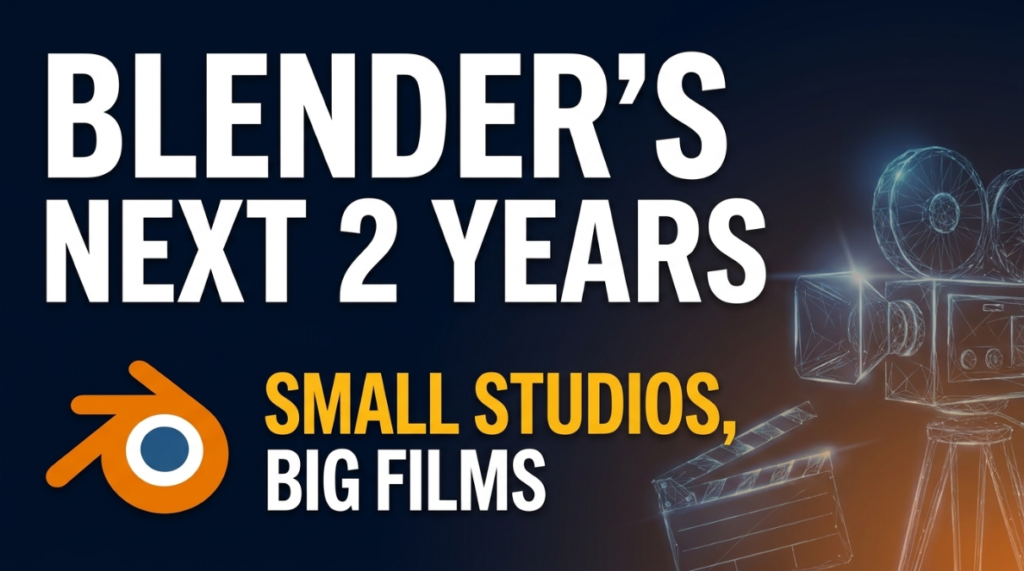
Blender’s plans are normally discussed one release at a time: what lands in the next version, what slipped. A post published on 10 September by Dalai Felinto on the Blender Developers Blog does something different. It names a two-year target, and the target is not a feature.
For the next two years, we want to focus on making Blender the tool that enables small independent studios to work on long-form projects, such as an animated feature film.
The six areas
Dynamic Overrides. A simple and efficient way to override property values of any data-block, linked or local. It is described as a multi-year effort that still needs testing and design refinement. In practice it means changing anything on a linked character inside a shot file without breaking the link.
Animation tools. Stronger filtering for keys and curves, layered animation, curve editing, and visualisation through motion paths and onion skinning.
Rigging at scale. A more opinionated and complete rigging system, so artists with limited technical background can reach rigging tools: meta-rig setup, modular frameworks, and UI pieces like bone pickers.
Editorial. The VSE acting as a status tracking system across stages of a project, from script breakdown and early beat boards through to final delivery, with Blender Studio’s Watchtower cited as the inspiration.
Collaborative asset creation. Expanding the Asset Pipeline add-on so several artists can sync individual changes to the same asset file.
Complexity management. Texture layers, light linking, render passes and dependency visualisation, aimed at giving artists real insight into the data they are working with.
The cost of focus
Felinto frames this as an agenda rather than a freeze: with the current team size and funding projections, other projects should still be able to run in parallel. But the post is also plain that time may not be available to review features outside the agenda. Anyone who has tried to land a patch in Blender knows that review time, not coding time, is the scarce resource, so that sentence carries more weight than the roadmap items do.
The list is also presented as provisional. Felinto says they want to hear from more Blender-centric studios about priorities and challenges the list does not address, which is an unusually open way to publish a two-year plan.
OVERGROWN is the test bed
Blender Studio’s feature film OVERGROWN launches on 14 September 2026 and is the production these tools get proven against. That is what makes the list credible rather than aspirational: a studio using the software daily on a long-form project produces concrete bug reports and concrete missing features, in a way that synthetic test scenes never do. It also ties the plan to a project that has had its own funding pressure this month.
What it means if you make games
Two of the six overlap directly with game work. A more complete rigging system with meta-rigs and bone pickers is the kind of thing that saves a small team hiring a technical artist, and better curve filtering and layered animation help anyone authoring clips for Unreal or Unity. The other four are film pipeline concerns — overrides, editorial, asset syncing, scene complexity — and they matter to you only once your team is big enough that several people touch the same file.
The honest read is that the next two years of Blender development go into scale and pipeline rather than new creative toys. Sculpting, texturing and real-time rendering keep moving, but they are not what the plan is pointed at. If you were waiting on one of those, plan around the modules as they are today.