Here is a frustration every stylized character artist knows. The model looks clean. The topology is fine. Then you light it and the face goes blotchy, the jaw catches a weird shadow, and the cheek reads as lumpy. Nine times out of ten that is not your modeling. It is your normals, and it is the single most misdiagnosed problem in anime-style 3D.
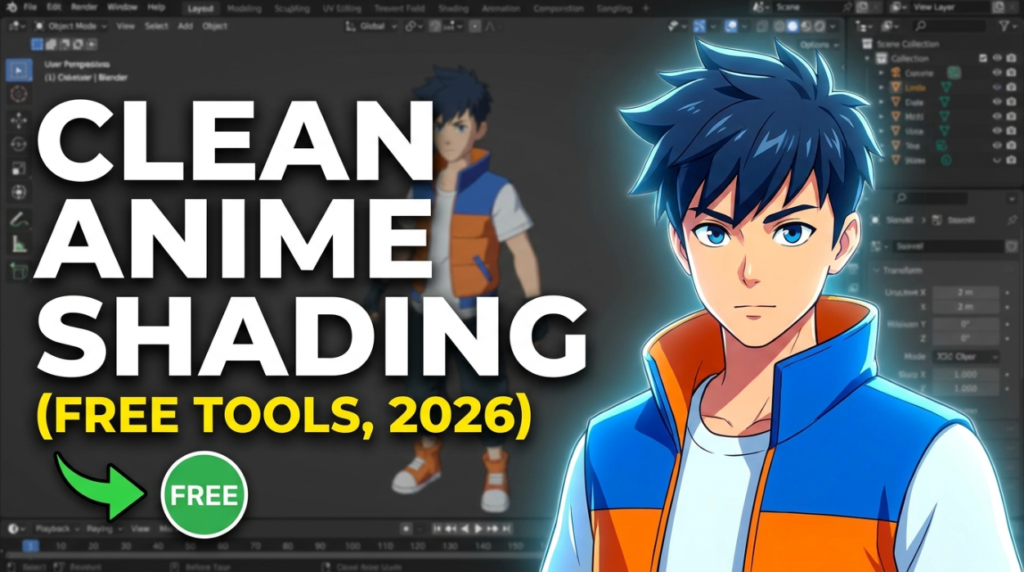
Fix the normals first
Easy Custom Normals smooths distorted normals using Geometry Nodes, so you get clean toon shading even on imperfect or triangulated topology. Quick way to check whether this is your problem: put a plain matcap or a single hard light on the face and rotate it. If the shading crawls and pools in patches, it is normals, not topology and not the shader.
Add outlines without building a compositor
Outlines by Kito Studio adds clean, customizable outlines for toon and NPR looks, saving you from wiring up a compositor or material setup on every project.
Hair and motion
Stylized hair has its own shading rules, and the free Stylized Hair Shader ships with a project file and walkthrough so you can pull the setup apart. For motion, SMEAR adds smear frames, motion lines and in-betweens, the hand-drawn tricks that make 3D read as 2D animation.
Or go fully 2D
If you want a crisp pixel-art look straight out of EEVEE, Pixel Art Rendering handles dithering and multiple light sources.
The order that matters
Normals first, then outlines, then hair and motion. Fixing shading shape before adding effects saves you from stacking fixes on top of a problem that was never solved. All of these are in the 3DxDEV Library, and more free tools are in our 2026 add-on roundup.