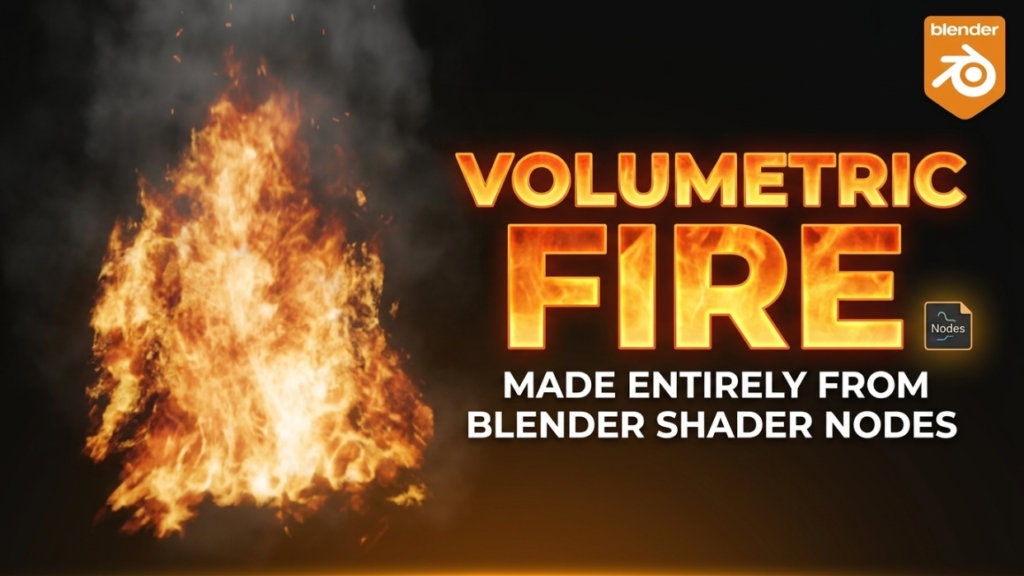
Fire is one of the hardest things to fake in 3D. Most artists reach straight for a simulation — set up a domain, bake a cache, wait, tweak, bake again. So when Blender artist Kronos197197 posted a convincing volumetric fire built with nothing but shader nodes, r/blender took notice. The post picked up more than 750 upvotes and sparked a long comment thread.
No Simulation, No Cache, No Bake
The claim in the title is the whole story: this fire was created procedurally, entirely with shader nodes. There is no smoke domain, no fluid solver, and no baked simulation data sitting on disk. The flame shape, the movement, the colour falloff from white-hot core to smoky tips — all of it comes out of a node network.
The artist described it as roughly three days of work, and by their own account the most complicated shader they had ever attempted. That tracks. Getting procedural noise to read as fire rather than as animated fog means solving several problems at once: the upward drift, the way flames pinch and break apart as they rise, the density falloff, and the emission ramp that sells the heat.
Why Shader-Based Fire Is Worth Learning
A procedural approach trades away some physical accuracy, but what you get back is significant:
- Zero bake time. Change a parameter and see the result immediately. No re-simulating, no waiting on a cache to rebuild.
- No disk footprint. Simulation caches for volumetric fire can run into many gigabytes. A shader network is a few kilobytes inside the .blend.
- Infinite loopability. Procedural animation driven by noise can be made to tile in time, which is awkward to achieve with a solved simulation.
- Full art direction. When every aspect is a slider rather than a physics result, you can push the look somewhere stylised without fighting the solver.
The Bigger Picture
Procedural volumetrics have quietly become one of the most interesting corners of Blender. The same fundamentals behind this fire — layered noise driving a volume shader, with careful control over density and emission — underpin procedural clouds, nebulae, smoke, and atmospheric effects. Studying a setup like this one is time well spent for anyone wanting to get comfortable with volume shading.
It is also a reminder that impressive results do not always require the heaviest tool available. Three days, a node editor, and a lot of patience got this artist somewhere a simulation would have taken far longer to reach.
See It For Yourself
The original post includes video of the fire in motion, which is really the only way to judge this kind of work. Head over to the thread on r/blender to watch it and read through the discussion. Full credit for the project goes to Kronos197197.