
LingBot-Map is a feed-forward 3D foundation model that reconstructs scenes from a plain video stream — one moving camera, no LiDAR, no depth sensor, no multi-camera rig. Released by the Robbyant Team under the Apache 2.0 licence, it has drawn over 12,000 GitHub stars and 1,300 forks.
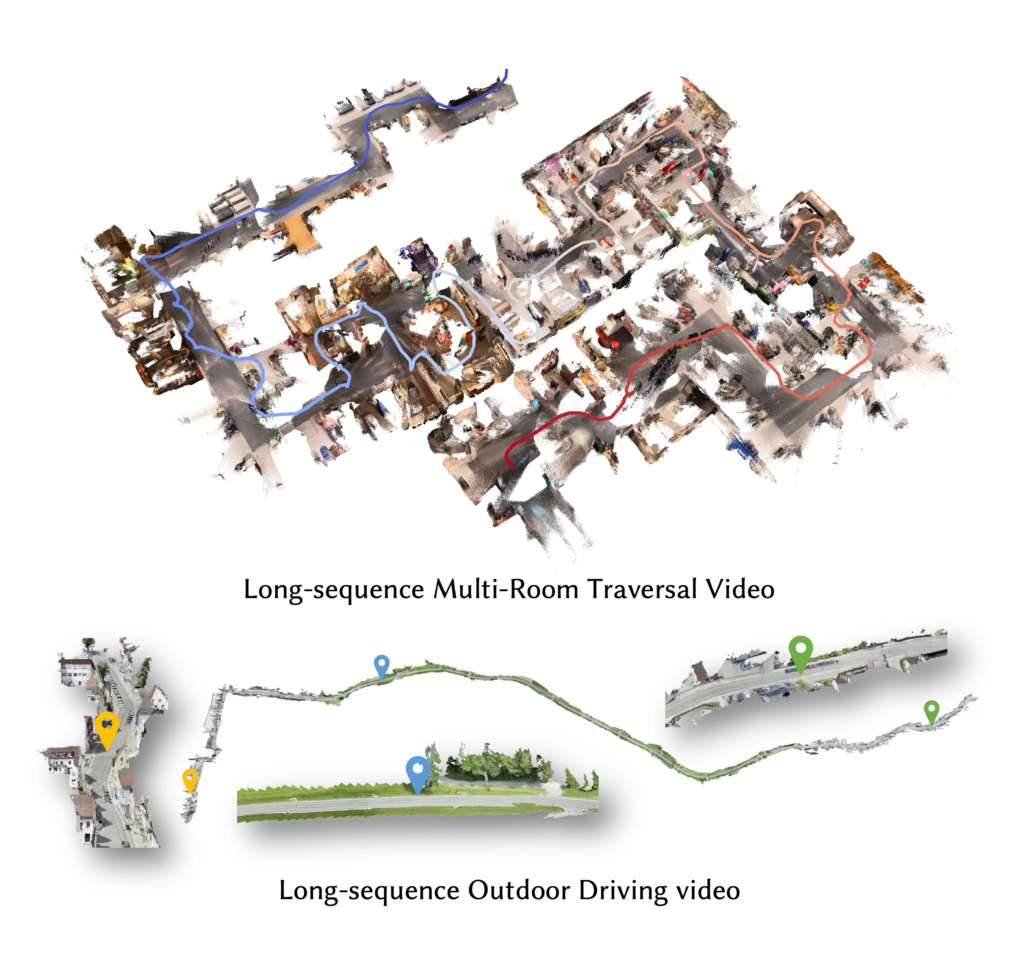
The technical name is the Geometric Context Transformer. In practice: you feed it a video, and it streams out a 3D point cloud and camera trajectory as it goes, rather than crunching the whole sequence offline the way photogrammetry does.
What Makes It Different
Traditional photogrammetry and COLMAP-style pipelines are optimization-based: they solve the whole scene at once, slowly. LingBot-Map is feed-forward and streaming — each frame is processed as it arrives, using paged KV cache attention borrowed from LLM inference.
The headline number is roughly 20 FPS on sequences exceeding 10,000 frames, with the team demonstrating a 25,000-frame, 13-minute indoor walkthrough. Drift correction is handled through anchor context, a pose-reference window and trajectory memory, which is what keeps very long sequences from collapsing.
Verified Capabilities
- Monocular input — handheld video, drone footage, driving footage, indoor walkthroughs
- Interactive browser viewer for live inspection during reconstruction
- Offline batch renderer that outputs point-cloud flythrough MP4s with scripted camera paths
- Sky masking via an ONNX segmentation model for cleaner outdoor scenes
- Three checkpoints — balanced, long-sequence, and a stage-1 model — on Hugging Face and ModelScope
- Benchmarked against KITTI, Oxford Spires, ETH3D, Tanks and Temples, TUM-D and others
The Details the Viral Posts Leave Out
Worth knowing before you clear an afternoon for this:
- That 20 FPS figure is at 518×378 resolution. This is not 4K reconstruction in real time.
- It outputs point clouds, not meshes. There is no mesh export, no UVs, no textures, and no FBX or GLB. Getting a game-ready asset out of this is still your job.
- You need an NVIDIA GPU. Setup expects CUDA 12.8 and PyTorch 2.8, with FlashInfer recommended. A community fork exists for 8 GB cards, which tells you the default VRAM appetite is not small.
- Long sequences need tuning. Past roughly 320 frames you switch to keyframe intervals, and past a few thousand to windowed mode. The README is upfront that pose collapse can happen otherwise.
- No DCC integration. Nothing ships for Blender, Maya or any engine.
Who Should Actually Try It
Technical artists, researchers and pipeline developers with an NVIDIA workstation. If you want scene reconstruction you can drop into Blender this afternoon, conventional photogrammetry still gets you a textured mesh and this does not.
What is genuinely notable is the licence. Apache 2.0 means commercial use is permitted — unusually permissive for a model of this capability, and the reason it matters more than the frame rate.
Developer: Robbyant Team · Licence: Apache 2.0 · Requires: NVIDIA GPU, CUDA 12.8, PyTorch 2.8
Point clouds are not meshes — a distinction we cover in photogrammetry vs gaussian splatting. For turning captured data into usable geometry, see our retopology guide.