
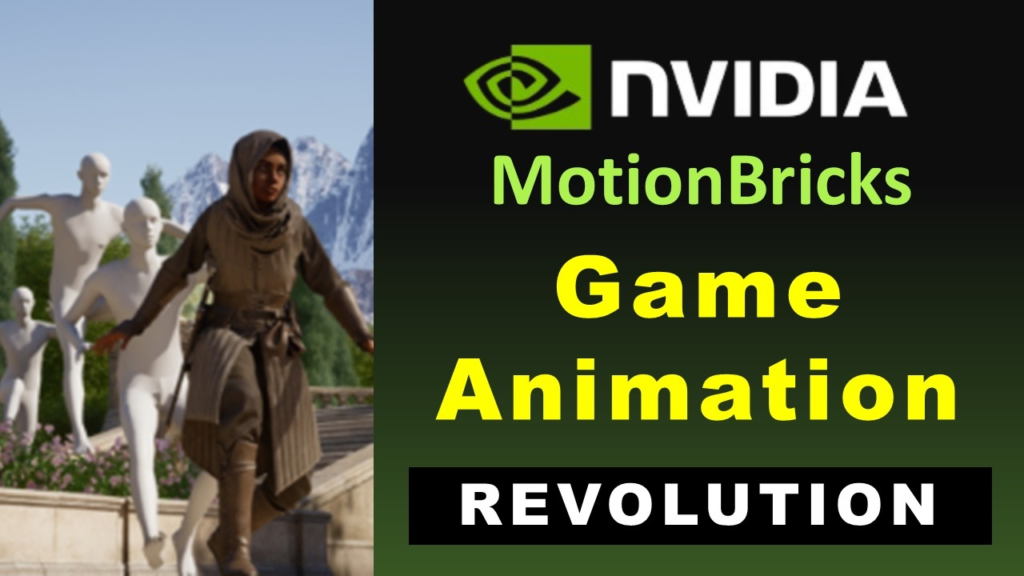
MotionBricks is NVIDIA’s real-time motion generation framework, presented at SIGGRAPH 2026. A single neural backbone covers over 350,000 motion skills, running at 15,000 FPS with 2 ms latency.
The headline demo is a 2:40 uncut Unreal Engine 5 sequence where every motion is neural — no foot-locking, no blending, no collision detection, no hand-authored transitions.
How It Works
Two parts. A modular latent generative backbone trained on 350,000+ motion clips, and smart primitives — a plug-and-play authoring interface that sits on top.
Smart Locomotion takes velocity, heading and style commands and composes movement from them. Styles demonstrated include zombie, injured-leg, injured-torso, skipping, strafing and crouch strafing — all zero-shot from a single prompt, with continuous runtime transitions between speed, direction and gait.
Smart Objects handle interaction. You supply a flexible set of proxy keyframes and the backbone fills in the approach, the contact and the follow-through — with natural variation between runs, so repeated actions do not look identical.
NVIDIA states it applies to new downstream tasks zero-shot, with no fine-tuning or task-specific tagging.
The Same Model Drives Robots
MotionBricks is a core component of NVIDIA’s GR00T Whole-Body Control stack, powering its motion-generation layer. The same network that animates a game character also controls physical humanoid robots — which is unusual, and explains why the paper is filed under robotics rather than graphics.
What Is Actually Released
Read this before clearing a weekend. It is a preview release, not the full system. What ships today:
- An interactive demo of a lightweight MotionBricks-controlled G1 robot
- A self-contained synthetic training pipeline, with instructions for incorporating the BONES-SEED dataset
NVIDIA targets a full release roughly a month out, with the model embedded in GR00T’s robotics formulation plus the complete training pipeline. Reproducibility experiments are described as in flight.
There is no Unreal or Unity plugin for general game use. The UE5 demo was built by NVIDIA’s own art team.
The Training Data Is the Story
MotionBricks is trained on BONES-SEED — 350,000 production-grade mocap clips captured from real human actors and actresses. Retargeting is handled by the SOMA Retargeter, a Newton-based solver that maps SOMA capture onto the G1 skeleton.
Worth sitting with: this system exists because hundreds of thousands of clips of real human performance were captured first.
Related NVIDIA Work
NVIDIA positions Kimodo as the sibling project — offline motion generation, complementary to MotionBricks’ real-time runtime. If you have used the Kimodo Blender Bridge, this is the other half of the same research effort.
Developer: NVIDIA (NVlabs) · Status: Preview release · Venue: ACM TOG / SIGGRAPH 2026