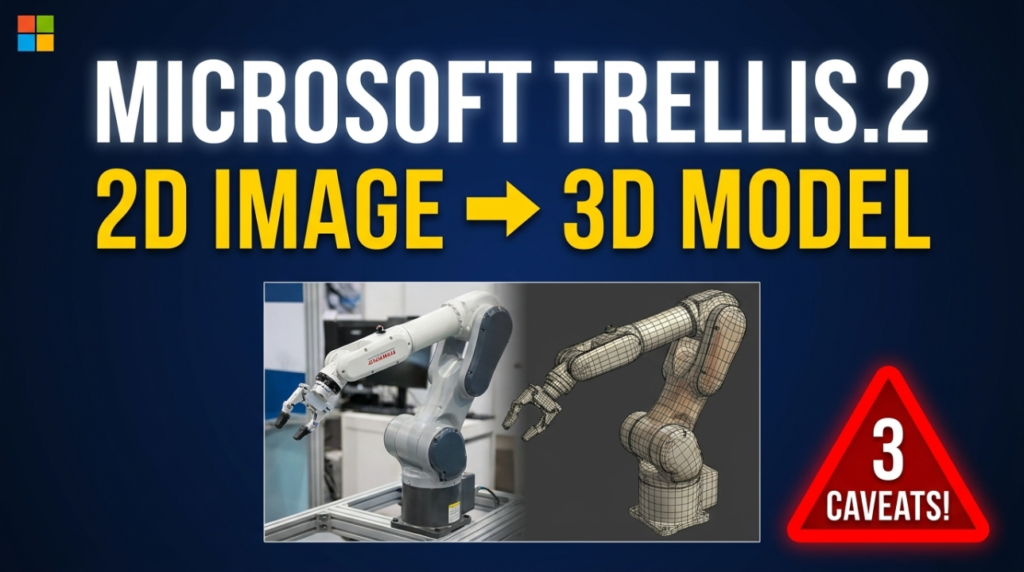
Microsoft has released TRELLIS.2, a 4-billion-parameter image-to-3D model, under the MIT licence with the complete training codebase. It has passed 10,900 GitHub stars.
The claims circulating about it are unusually close to accurate — which is rare in this category. But three details are being dropped, and they decide whether you can actually use it.
What Is Genuinely Impressive
Real PBR materials. Most image-to-3D tools give you a mesh with a colour texture. TRELLIS.2 outputs base colour, roughness, metallic and opacity as separate properties. That is the difference between an asset that looks flat under studio lighting and one that reads as metal, plastic or fabric.
Topology other models break on. Its O-Voxel representation avoids iso-surface conversion, so it handles open surfaces like clothing and leaves, non-manifold geometry, and internal enclosed structures. Anyone who has watched a generator turn a jacket into a sealed blob will understand why this matters.
The training code is public. Not just weights — the full pipeline. You can fine-tune on your own asset library and get a model that generates in your studio’s style. For a studio with a large back catalogue, that is the genuinely interesting part.
Correction One: The Three Seconds
True, but at 512³ resolution on an NVIDIA H100. Microsoft publishes the rest: 1024³ takes about 17 seconds and 1536³ about 60, on the same datacentre hardware.
Three seconds is the fastest setting on one of the most expensive GPUs made. It is not what you will see locally.
Correction Two: “Runs Locally” Has Conditions
It runs locally if you have Linux and an NVIDIA GPU with at least 24 GB of VRAM. The repository states the code is tested only on Linux and verified on A100 and H100 cards.
No Windows support. No 8 GB consumer card. For most artists, “runs locally” is not true of the official release — though the Hugging Face demo lets you try it in a browser for nothing.
But this is already being solved. Community C++/GGML ports now run the same pipeline without CUDA or PyTorch, loading GGUF weights directly. LocalAI publishes two profiles — the full 1024³ cascade with PBR at around 18 GB, and geometry-only at 512³ at around 7 GB — with the backend degrading gracefully depending on which components you have. A separate independent port adds a Vulkan backend, which brings AMD hardware into scope.
That is the real story here: the model shipped for datacentre GPUs, and within weeks the community had it running on consumer cards.
Correction Three: “100% Open Source” Is Nearly Right
The model and code really are MIT. But the repository flags that certain dependencies carry separate licence terms — nvdiffrast for rendering and nvdiffrec for the PBR split-sum renderer.
If you are shipping commercial work, read those terms rather than trusting the badge. This is the same trap we noted with Alibaba’s video ControlNet: open weights and open source are not the same claim.
Is It “Production-Ready”?
For props, set dressing, scanned-object replacements and previs — close to it, and the PBR output genuinely shortens the path to engine.
For characters, no. Topology generated from a voxel process is not topology an artist would author, and nothing that gets rigged and deformed will survive without a retopology pass. That is not a criticism of TRELLIS.2 specifically — it is true of every generator, and it is why retopology tooling has been quietly booming alongside AI generation.
One practical gotcha: exported GLB files default to OPAQUE mode. The alpha channel is in the texture but not connected, so transparency looks broken until you wire it to the material’s opacity input yourself.
Where This Sits
Against Tripo, Meshy, Rodin and Hunyuan3D, TRELLIS.2’s advantages are the PBR material output, the topology robustness, and a permissive core licence with public training code. Its disadvantage is accessibility — the others run in a browser, this one wants a workstation.
The pattern is now familiar: research ships as weights and scripts, and the artist-facing layer arrives months later. Given the MIT licence, the C++ ports arrived within weeks. A Blender add-on is the obvious next layer — and that is when most artists will actually use it.
Full comparison in our guide to AI 3D model generators.