
TRELLIS.2 is Microsoft’s 4-billion-parameter image-to-3D model, released under the MIT licence with the full training codebase. It generates textured meshes with genuine PBR materials from a single image, and it has drawn over 10,900 GitHub stars and 1,300 forks.
The technical foundation is a representation called O-Voxel — a “field-free” sparse voxel structure that avoids the iso-surface conversion most 3D generators rely on. That is what lets it handle geometry other models mangle.
What Makes It Different
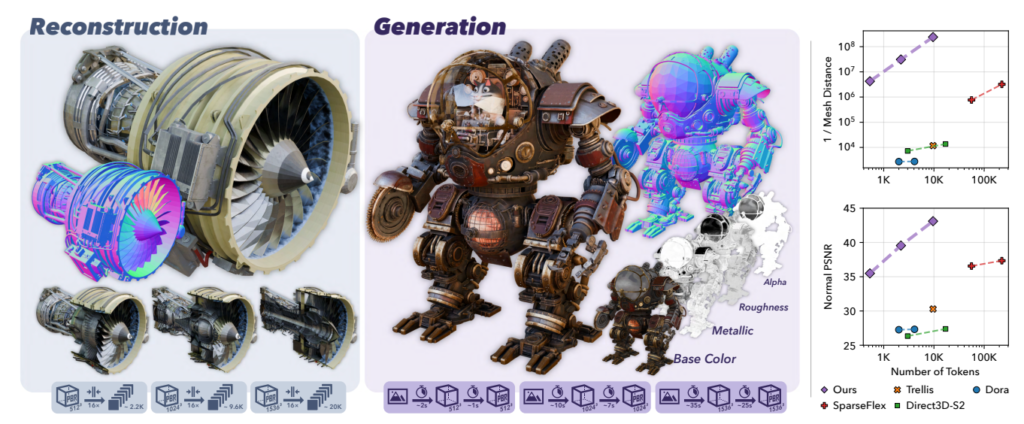
- Real PBR output — not just base colour. It models base colour, roughness, metallic and opacity, so materials respond correctly to lighting rather than looking like painted albedo.
- Arbitrary topology — open surfaces such as clothing and leaves, non-manifold geometry, and internal enclosed structures all survive. Most generators fail on exactly these.
- Multiple resolutions — 512³, 1024³ and 1536³, so you trade time against detail.
- Standalone texturing mode — you can feed it your own mesh and have it generate PBR textures for that shape, separate from full generation.
- GLB export with up to 4096px textures, ready for Blender, Unity or Unreal.
- Full training code — you can fine-tune on your own asset library to match a house style.
The Speed Claim, Accurately
The widely quoted “3 seconds” is real but specific: it is 512³ resolution on an NVIDIA H100, split as 2 seconds for shape and 1 second for materials.
Microsoft’s own published figures for the other resolutions:
- 512³ — about 3 seconds
- 1024³ — about 17 seconds
- 1536³ — about 60 seconds
All on datacentre hardware. On anything less, expect considerably longer.
What You Actually Need to Run It
This is the part most coverage omits, and it rules out a lot of people:
- Linux only. The code is tested only on Linux — there is no Windows support.
- An NVIDIA GPU with at least 24 GB of VRAM, verified on A100 and H100.
- CUDA Toolkit 12.4 and a Conda environment, with a lengthy dependency build.
If you just want to see what it produces, Microsoft hosts a Hugging Face Spaces demo you can use in a browser with no setup.
Licence: Read Past the MIT Badge
The model and code are MIT, which is genuinely permissive. But the repository notes that some dependencies carry their own separate licence terms — specifically nvdiffrast, used for rendering, and nvdiffrec, used for the split-sum PBR renderer.
If you plan to ship commercially, check those terms rather than assuming the MIT badge covers the whole stack. “100% open source” is close, but not exactly right.
Practical Notes
Exported GLB files are written in OPAQUE mode by default. The alpha channel is preserved in the texture but not connected — you have to wire it to the material’s opacity input yourself once imported. Worth knowing before you conclude transparency is broken.
And as with every generative 3D tool, topology comes from a voxel process rather than an artist. It is excellent for props, scans and set dressing. For anything that will be rigged and deformed, plan a retopology pass.
Developer: Microsoft · Licence: MIT (dependencies vary) · Requires: Linux, NVIDIA GPU 24GB+ VRAM
See our comparison of AI 3D generators and the five questions that tell you whether any of them is usable.