
Stair Geometry Node is a free Blender Geometry Nodes setup that builds stairs procedurally. Resize the object in Edit Mode and the staircase rebuilds in real time — the step count adjusts automatically based on height and length, or you can set it numerically.
It comes from Japanese creator kksbluesky, and it is free.
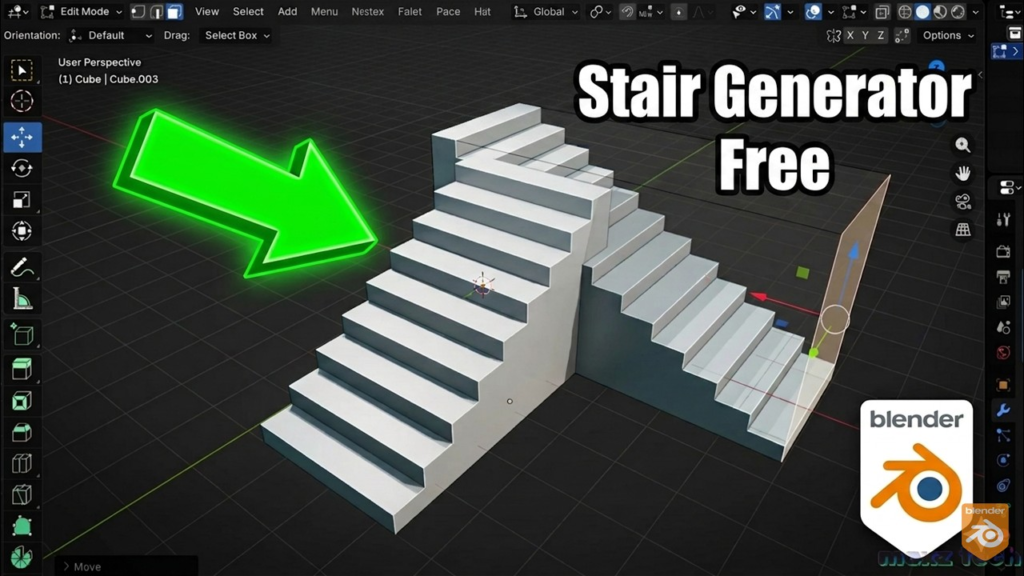
Why Stairs Are Genuinely Annoying to Model
Stairs look like the simplest possible modelling task and are one of the most tedious in practice. A staircase is a repeating unit constrained by two dimensions that keep changing.
Model twelve steps by hand, then the architect raises the floor height by 300mm. Now you need thirteen steps, each slightly shorter, and the whole thing has to be rebuilt. Do that across a multi-storey building and it is a genuinely significant amount of time spent on geometry nobody will look at.
Procedurally, it is a slider.
The Automatic Step Count Is the Point
This is the feature that separates it from a simple array modifier.
Real stairs have to satisfy a relationship between rise and run — step height must stay within a comfortable range, so changing the total height must change the number of steps, not just stretch the existing ones.
An array modifier will happily give you twelve absurdly tall steps. This adapts the count instead, which is how stairs actually work and why the result stays plausible at any height.
Real-Time Editing
Because it responds in Edit Mode, you can drag the staircase to fit a space and watch it resolve. That matters more than it sounds for architectural work, where stairs almost never get their final dimensions on the first attempt.
Where You Would Use It
- Architectural visualisation — the obvious case, and where the time saving is largest
- Game environments — level blockouts where stair dimensions change during iteration
- Motion graphics and previs — fast, correct-looking staircases without committing modelling time
- Learning Geometry Nodes — see below
Worth Opening as a Study Piece
Stairs are an unusually good Geometry Nodes learning subject. The setup has to solve counting from a measurement, distributing instances evenly along a length, and keeping proportions correct as inputs change.
Those are the same problems behind fence posts, window mullions, ladder rungs, shelving, railings and seating rows. Understand this node tree and you can build all of them.
It is small enough to follow end to end, which is more than can be said for most procedural setups worth studying.
Version Compatibility
Built in Blender 3.0, with operation confirmed from Blender 3.0 through 4.3. It predates Blender 5.x, so if you are on a current release, test it before relying on it in production — Geometry Nodes has changed since, and node setups occasionally need updating across major versions.
The product page is in Japanese with an English translation. Worth noting that a lot of excellent Blender tooling comes from the Japanese community and never reaches English roundups — our resources directory lists the sites worth following for exactly that reason.
Related Free Tools
More procedural setups in our Geometry Nodes roundup, and see the best add-ons for procedural modelling.
Creator: kksbluesky · Price: Free · Requires: Blender 3.0–4.3